.
.
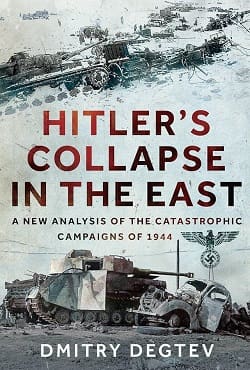
by Dmitry Degtev.
Hardback (6.5×9.5 inches). 206 pages. 2025.
Subtitle: A New Analysis of the Catastrophic Campaigns of 1944
This fast-reading operational overview of various Soviet offensives that hammered the Germans through 1944 offers a varying degree of “new analysis” depending on how many books you read about the WWII Eastern Front.
To me, the salient points were: Soviets used tactical air strikes much more extensively; German transfers of units to plug gaps created weak spots that were subsequently attacked and exploited; Hitler’s no retreat rule made such exploitations worse as the Soviets learned to pocket and seal the pockets of German troops — not every time, but enough to cause German losses in men and material; Soviet sappers would infiltrate German minefields at night and bury Soviet mines — just before an attack, the Soviets would detonate mines and set off chain reactions of German mines, clearing paths for the attacking Soviet troops; and USSR used cavalry to increase mobility and exploitations during muddy seasons — helping disrupt rear areas and pocket even more Germans. German counterattacks to relieve the pockets are included.
This type of analysis is embedded within the historical narrative, which is a nice way to emphasize certain aspects of the Soviet way of war.
Couple typos: “heavy Tiger tanks” (p16) is duplicated; “troops occupied a square ledge about 100km wide” (p21) is off — perhaps “wedge”; and “largets” (p93) should be “largest.”
The book contains 32 black and white photos and seven black and white operational-level maps without a scale.
Enjoyed it.
— Reviewed by Russ Lockwood