.
.
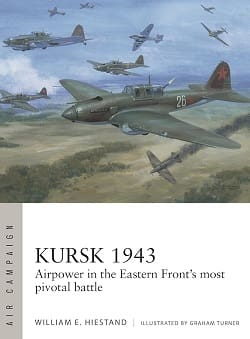
by William E. Hiestand.
Softcover (7.25×9.75 inches). 96 pages. 2025.
Subtitle: Airpower in the Eastern Front’s Most Pivotal Battle
The usual tiny font Air Campaign format includes: Chronology, both sides’ capabilities and orders of battle, objectives, the actual campaign, and the aftermath. It’s all in this volume, too, along with the plethora of photos and illustrations.
Although Kursk has been well covered, the air war provided a bit of a surprise — German efforts to destroy the rail lines and airfields leading to the salient. It’s the same objective as the US had in 1944 ahead of D-Day, only the Germans had fewer aircraft to do it. The results were so-so.
The booklet covers the aerial assaults and defenses divided by north and south pincers. While an overview, the missions and goals intertwine with responses and overall losses. While both sides made a maximum effort, the Soviets eventually started to fight the Luftwaffe to a draw and in some spots flew more sorties than the Germans. However, Soviet air losses were so high, pilots were starting to fly only over their own troops to avoid German flak and fighters (p87).
The booklet contains 60 black and white photos, three color photos, five color maps, three color diagrams, and three color two-page action illustrations.
The German close air support remained potent, but it was not enough to pave the way for the panzers. The Soviets did just enough to stymie the Luftwaffe at Kursk before the Germans called off the attack.
Enjoyed it.
— Reviewed by Russ Lockwood