.
.
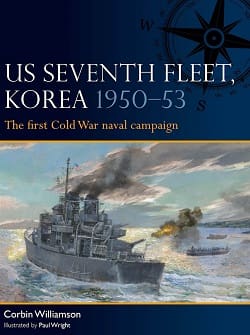
by Corbin Williamson.
Softcover (7.25×9.75 inches). 96 pages. 2025.
Subtitle: The First Cold War Naval Campaign
After WWII, the US Navy drew down its manpower from 3.4 million in 1945 to 375,000 in June 1950 when the Korean War started (p36).
Meanwhile, the number of operational USN ships fell from 6,700 in August 1945 to 842 in June 1947 (p5). The lack of trained personnel to man existing and reactivated whips was made up with reservists, who took time to become reacquainted with wartime operations.
As per the Fleet series, both sides’ forces, commanders, command and control, and communications are analyzed against the general background of the period — in this case, post-WWII events in China.
On the plus side, the only significant naval combat occurred when four North Korean motor torpedo boats and two gunships tangled with the light cruisers USS Juneau and HMS Jamaica and supporting ships. All six of the smaller North Korean ships were sunk or severely damaged.
Four major operations are covered: Pusan Perimeter of close air support and supply; Inchon and amphibious assault; Interdiction of China with air strikes against bridges, bombardments against troops, and close air support by carrier air groups; and bombing campaign against high-value North Korean targets such as dams and industrial infrastructure.
Interesting that carrier air groups lost 10% of propeller-driven fighters each month to combat damage, accidents, and other write-offs (p45).
Also of interest is a look at the logistical operations that brought war material from the US to Japan and then to Korea. In some ways, it was relearning the WWII processes.
The booklet contains 29 black and white photos, three color photos, one black and white illustration, six color maps, six color diagrams, three color two-page action illustrations.
The USN had its work cut out for it in Korea after five years of peace. This volume explains how it re-learned to be as potent during the Korean War as in WWII.
Enjoyed it.
— Reviewed by Russ Lockwood