.
.
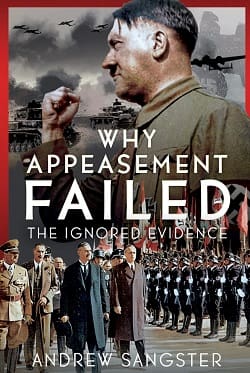
by Andrew Sanger.
Hardback (6.4×9.5 inches). 199 pages. 2025.
I’m not sure the title should be Why Appeasement Failed as much as How Appeasement Failed. The why seems obvious: you can’t negotiate with a German psychopath leading a government of psychopaths. How that psychopath managed to pull off gaining the government and conducting diplomacy in the 1930s is the how and the crux of the book.
Neville Chamberlain comes off as the appeaser in chief, but that ignores previous UK prime ministers’ efforts to bribe Hitler to not start a second world war. And it’s not only the Brits. The French were just as culpable. “Munich’s ‘Peace in our time’ was merely pulling the pin on a hand grenade.” (p77)
It was a feeling of the times that after the horrors of WWI, adjusting a boundary line seemed a small price to pay to prevent another war. Yet, as we know, the line kept moving until it became a red line covering the Polish border.
These diplomatic moves and countermoves are succinctly explained, but the key to the book is examining period literature that warned about Hitler’s plans and methods, but was ignored. The analysis of Mein Kampf and other books provides endless speculation about what might have been had the warnings been heeded.
Of course, hindsight is marvelous. Propaganda muddies clarity. Did it really take the conquest of Czechoslovakia to figure this out?
Apparently. Nonetheless, examination of several key books and journalistic reports uncover a significant shift in cultural activity that lead to the Third Reich becoming an oppressive society bent on expansion. Mein Kampf might be a madman’s almost incomprehensible manifesto, but the plan was explained. Taking over school curriculum. Exterminating the free press. Turning minority groups into villains. These are all hallmark of dictatorships, Third Reichs, and otherwise.
Interesting that in January 1934, Hitler signed a 10-year non-aggression pact with Poland (p162), which may have been tied into the German rearmament plan.
A few typos: “eastern European eastern Jews fled” (p156) has one too many easterns; “to serve German is” (p156) reads better with Germany; and “state.He” (p168) and “between1929-32” (p169) are both missing a space.
The book contains 24 black and white photos.
Reading the signs is always imperfect in the moment and yet goals and aggressions were all laid out in multiple 1930s books and reports. Hindsight or otherwise, this book takes you through the main ones. We would do well to understand how past outlines can be applied to current analysis.
Enjoyed it.
— Reviewed by Russ Lockwood