.
.
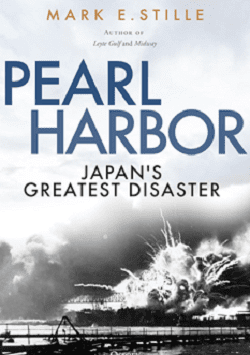
by Mark Stille.
Hardback (6.4×9.5 inches). 328 pages. 2025.
“December seventh, 1941, a date that will live in infamy…”
Japan’s attack on the US fleet and aircraft at Pearl Harbor served as the event for the US to become involved in WWII. Why Japan came to the decision to war on the US and how Adm. Yamamoto and his staff created the attack plan set up a detailed analysis of the attack itself.
Incidentally, according to Japanese calculations, the US 1940 Two-Ocean Navy bill meant Japan would only have 76% of US strength in 1941, 50% of US strength by 1943, and 30% of US strength by 1944 (p57).
The Japanese performed tabletop wargames about an attack on Pearl Harbor with two carriers as early as 1927 (p66). It was judged unsuccessful. On Sep. 11, 1941, the first wargame of an air strike on Pearl Harbor resulted in the loss of two carriers and 50% of the aircraft.
The second wargame that day was a success, but then again, the Japanese counted one Zero equal to three US aircraft (p72). Another wargame was held Oct. 12, 1941 using only three carriers but including submarines (including midget subs) was judged a moderate success (p77-78).
As for the real attack, plane by plane, torpedo by torpedo, and bomb by bomb, the expert Japanese airmen didn’t do as well as expected, although the carnage was severe enough to put the battleship portion of the fleet out of commission for months to years. Two never were repaired. Fortunately for the US, the aircraft carriers were out and about delivering planes and scouting.
Japanese aircraft handling processes on carriers could launch the prepared first strike wave in 15 minutes and the second wave soon left and then the carrier force turned and headed away. However, recovery and turn-around time of returning aircraft was another matter.
This turnaround time needed also argued against launching a second strike — not that Adm, Nagumo was ever going to launch a second strike. A second strike return time for early December would mean a night landing. That’s something the inexperienced aviators on Shokaku and Zuikaku were unable to do. Indeed, they were unable to launch in darkness – a point new to me.
Of note, and in detail, the Japanese submarines that were supposed to be blockading Pearl Harbor and sinking ships entering or leaving proved ineffectual at best. Partly, and this is new to me, it revolved around generally passive Japanese submarine operating procedures. Well explained and interesting, that.
An odd tidbit: In Jan-Feb 1941, Yamamoto entertained an option that would send 500 to 600 aircraft on a one-way mission to Pearl Harbor, with the pilots and crew ditching in the ocean to be picked up by submarines and destroyers (p90). He was talked out of it.
Analysis would not be complete without examining a potential second strike that went after the oil tank farms and examining what would have happened if the US was alerted and ready for the attack.
One typo: “December 77” (p372) has an extra 7.
The book contains 40 black and white photos and six black and white maps. Excellent OOBs, too.
Pearl Harbor: Japan’s Greatest Disaster will mesmerize you with details and analysis of the Japanese attack and American response. It’s quite a captivating and smoothly-written account. Excellent.
Enjoyed it.
— Reviewed by Russ Lockwood