.
.
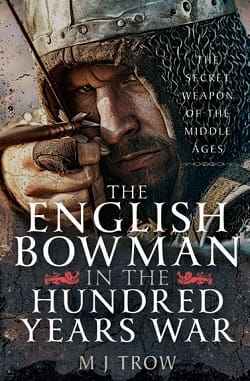
by M. J. Trow.
Hardback (6.5×9.5 inches). 234 pages. 2025.
Subtitle: The Secret Weapon of the Middle Ages
It took a king’s edict to mandate the youth of England practice with the bow until they were 17 years old. Then, they were the prime age to go off on campaign — and England had many campaigns.
The book starts with Bowman 101, covering training, bows, secondary weaponry, armor, and other basics. Then it moves into the various campaigns and battles, from 1346 (Battle of Neville’s Cross) to 1453 (Battle of Castillion — technically a bit beyond the 100YW, but bowman-valid nonetheless). Of course, you get the big three: Crecy, Poitiers, and Agincourt, and a number in between.
A quintet of chapters covers biographies of Edward III, Edward of Woodstock, Bertrand du Guesclin, Henry V, and Joan or Arc. Additional chapters cover the War at Sea, the Free Companies, and the transition to gunpowder weaponry.
It’s all well-paced and delves deep enough into detail without smothering you. You’d need additional references for tactical tabletop scenarios, but you can judge the impact of the English longbowmen on the French and Scots in how you treat missile fire.
A couple wrinkles. On page 16 and 18, the text mentions the “Goddamns,” which I thought, in context, was a family name. No previous mentions, just another capitalized name. Not true. The “Goddamns” was a French nickname for the English bowmen “because of their blasphemous profanity on the march” (p47). That would have been helpful 30 pages earlier. I had not heard of that nickname.
I suspect without any evidence that the looting, plundering, and raping of the French countryside during raids by the English might have had something to do with how the French felt. The French weren’t innocent. During the Battle of Agincourt, French knights slaughtered the boys guarding the English baggage. That was widely condemned at the time.
A couple typos: “. her” (p70) is missing a capital H, and, (p160) has a missing period at the end of a sentence.
One sour note and I can’t believe this got through the editing process. At Agincourt, Henry V ordered the execution of the French prisoners. “Today, this act of slaughter would be regarded as a war crime, with all kinds of pinko-liberal outrage underpinned by the Hague Convention…” (p173)
To be kind, it’s an inarticulate comment about how the present views a past atrocity during the middle ages. To be unkind, what a thoughtless statement. My “pinko-liberal outrage” is not against examining historical atrocities, but in vilifying those who would argue atrocities are intolerable.
The book contains eight black and white photos, 13 black and white illustrations, and four black and white maps.
I don’t want to let one inarticulate phrase ruin what was up to that point a competent examination of the English longbowman, but the phrase hardly appeals to our better angels.
Enjoyed it.
— Reviewed by Russ Lockwood