.
.
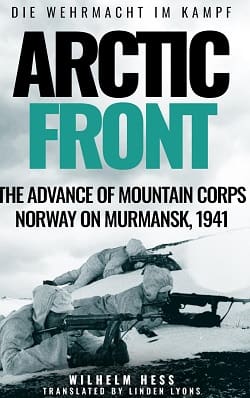
by Wilhelm Hess. Translated by Linden Lyons.
Softcover (6.0×9.0 inches). 232 pages. 2025 reprint of 2021 translation of 1956 book.
Subtitle: The Advance of Mountain Corps Norway on Murmansk 1941
I am always up for a read of one of these 1950s Wehrmacht Im Kampf books. Written by German commanders, they offer insight into the German way of war within the specific topic.
In this case, it’s written by the Quartermaster of the German Mountain Corps and offers a good operational look at the German far north offensive from Norway towards Murmansk. The Corps consisted of two divisions, the 2nd and 3rd, and later a third mountain division, the 6th, was added. Some assorted and associated units were attached and naval and air support was limited.
Supply was a problem in a place without even a decent road network. Summer was bearable as trucks could use “roads” and other tracks for most of the way to the front. Construction and Pioneer battalions did the best they could to build more roads and maintain all of them. I don’t know if any manufacturer makes snowplows and snowblower vehicles, but the three companies of the 602nd Snow Removal Battalion would use them. Small freighters could offload in some of the rear-area ports. Chapter 20 covers supply organizations and operations.
For example, in 1941, it took 14 to 20 days for items to move from Germany to Petsamo, and then another eight to 12 days to move from the port to the front line (p173). Talk about requisitioning items in advance!
The German mountain troops performed well against the more numerous Soviets — up to a point. Combat losses, spotty supply, and plenty of Soviet reinforcements soon had the 1941 German offensive halted. Hess even mentions British carrier strikes. Thankfully, many maps are included that give you a good idea of locations and topography — enough to figure out how to create tabletop battlefields.
The book contains 20 black and white maps and 10 black and white illustrations.
The German OOB for the 2nd Mountain Division (the 3rd Mountain is identical) uses period German symbols and is in German. If you are not familiar with such, you’ll need to look up the symbols and the German words.
I shouldn’t be surprised at the effort put into supplying the Corps in a remote spot, but I was. As I knew little about the Norway to Murmansk offensive, I found the combat deployments and operations quite interesting. Another fine Wehrmacht Im Kampf reprint.
Enjoyed it.
— Reviewed by Russ Lockwood