.
.
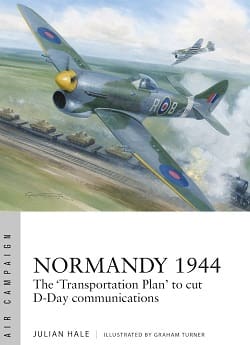
by Julian Hale.
Softcover (7.25×9.75 inches). 96 pages. 2025.
Subtitle: The ‘Transportation Plan’ to Cut D-Day Communications
The Allied destruction of railroad lines and bridges hamstrung the German efforts to send war material to the French coast prior to D-Day and combat troops to Normandy after D-Day. How the Allies overcame internal dissension between the USAAF commanders who wanted to go after oil installations versus those who wanted to go after transportation infrastructure forms an important element of this analysis.
The overall results of the ‘transportation’ bombing campaign were so-so: night bombing was fairly ineffective while daylight bombing could at times be incredibly effective. Overall 1944 daily running distance of trains in France and Belgium dropped from 120km to half that (p91). War-related trains were soon prioritized by the Germans at the expense of non-military and economic trains. Logistics still felt the pain, as train car loadings in June 1944 were only 20% that of March 1944 (p89).
One factoid from a late 1944 German survey: 12.2% of USAAF bombs failed to explode and 18.9% of RAF bombs failed to explode (p18). The damage could have been a little bit worse had all exploded…but it also explains why modern construction unearths so many unexploded WWII bombs.
One probably map typo (p28): The “12th” Panzer Division is likely the 21st Panzer Division. The 12th SS Panzer Division is correctly on the map.
The booklet contains 54 black and white photos, eight color photos, six color maps, two color diagrams, and three color two-page action illustrations.
Of note is a pair of photos: Aulnoye (France) RR marshalling yard before bombing (p8) and after bombing (p56). Multiply that type of damage over lots of yards and you get an idea of the amount of damage the Germans had to repair … or — in many cases — not repair.
The book Air Battles Before D-Day provides an overview of the entire bombing war in the years before the Allied invasion. Air Campaign 54 concentrates on the bombing campaign from January to June 1944.
Enjoyed it.
— Reviewed by Russ Lockwood