.
.
by Paul St. John Mackintosh
Hardback (6.5×9.5 inches). 241 pages. 2025.
The Vichy government doesn’t get a lot of play among the wargamers community. The British took out most of its navy in 1940. It contributed modest troops to the SS. Its forces in North Africa surrendered after less than a week of fighting in 1942 against the Allied forces of Operation Torch. Then the Germans overran Vichy France.
Yet within the political sphere, Marshal Petain did what he could to maintain the pseudo-independence of Vichy France, even if his efforts proved limited. Not that Petain was effective in all respects, but that he was in a no-win position.
That said, Vichy seemed like a political swirl of republican and fascist egos competing for scraps through four years of German occupation. Internecine political warfare among the French and competing agendas with the Germans mark most of this book. The voluminous and often repetitious excerpts of speeches and letters make for a dull read — at least to me. While accurate for the period, I skipped around the excerpts and text.
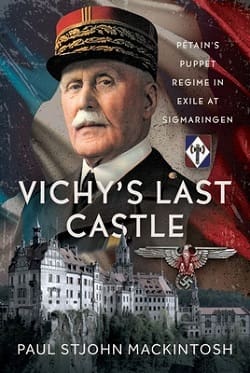
In late 1944, despite Petain’s objections, he and his entourage were moved to a castle at Sigmaringen (Germany). For the next five months, French exiles also arrived, where they proceeded to argue protocols and political comebacks. It was all like rearranging deck chairs on the Titanic, so to speak.
As the Allies approached, the Germans tried to move Petain again, but he objected. Indeed, his wife forcefully objected and they were eventually allowed to travel into Switzerland. Post war, the Swiss turned all over to the French — at least those that didn’t escape.
The book contains 18 black and white photos and one black and white illustration.
One typo: “remarkably modem in its approach” (p20) should be “modern.”
Petain was tried and sentenced to death, but deGaulle changed that to life imprisonment. Other members were executed. Some escaped to Italy and Spain and lived out their lives. Others were sent bWW2, ack to France and executed.
While covering a little-covered topic and generally well-researched, it’s not a smooth read and there is little that can translate to the tabletop.
— Reviewed by Russ Lockwood