.
.
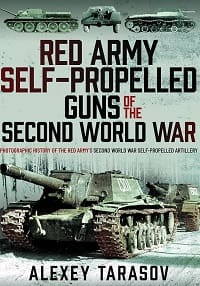
by Alexey Tarasov.
Hardback (6.4×9.4 inches). 226 pages. 2024.
Subtitle: Photographic History of the Red Army’s Second World War Self-Propelled Artillery
While often misused by the Soviets in WWII as tanks accompanying infantry, this class of armored vehicles eventually received proper doctrine and tactics by 1945. As a result, many were unnecessarily lost in a role they were not intended to perform. Yet, when employed as artillery, they could be extremely effective.
The book divides into two parts.
History (p1-73) includes design, development, production, and deployment as well as examining theoretical and actual doctrine and tactics. The first prototypes were trucks mounting howitzers and other guns before evolving into well-known SU-76M, SU-122, and SU-152 vehicles. Production during wartime often meant cutting corners, and several deficiencies, such as weak running gear, were never quite remedied and units suffered from numerous breakdowns and shorter than expected operational life.
Training was abysmal through 1943 with formations spending only two or three days in training before being sent to the front to learn on the fly (p23). Actual training was planned for eight to 10 days, but as noted, often shortened due to lack of training infrastructure, vehicles, and trained instructors. Brigades completed only 71.9% of combat training and only 25.6% of other training (maintenance, medical, AA, etc.) before being sent to the front (p29). The training manuals specified the SU-152 rate of fire at one to two rounds per minute, but in the real world, that often came out to one round every four or five minutes.
Photographs (p77-216) offers visual details of the vehicles as well as extensive captions about the vehicle or the photo itself.
The book contains 338 black and white photos and 12 black and white illustrations. It also contains a terrific Table of Contents listing every vehicle and variant for fast look up of specific vehicles. Kudos for the organizational excellence.
Interesting deployment: A battery of four vehicles would often deploy in one line, and sometimes two lines, with 40m to 50m between vehicles for SU-76 light and SU-122 medium SPGs and one vehicle every 50m to 75m for the large SU-152s. A regiment would space 100m to 200m between the batteries. If deployed in two lines, the second line would be 2,000m to 4,000m behind the first (p36). Note that direct fire at up to 1,000m was the preferred tactic in 1943 as indirect fire was generally ineffective (p37).
Enjoyed it.
— Reviewed by Russ Lockwood