.
.
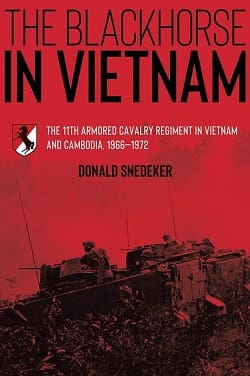
by Donald Snedeker.
Softcover (6.0×9.0 inches). 326 pages. 2023 reprint of 2020 book.
Subtitle: The 11th Armored Cavalry Regiment in Vietnam and Cambodia 1966-1972
The 11th was a self-contained unit with intrinsic infantry, artillery, armor, helicopters, and support subunits that became known for its rapid response to Viet Cong (VC) guerilla and regular North Vietnamese Army (NVA) attacks on convoys, bases, towns, and even Saigon. As it gained experience, it shifted from a support role for other divisions to a lead role in sweeps and attacks.
The initial ambushes, harrowing though they may be, provide excellent examples of combating guerrilla units that could pick the time and place of the ambush. In response, the unit developed aggressive tactics to foil the attacks, using the speed of M-113 APCs (modified with three MGs with gunshields), firepower of M-48 tanks, and airpower to support infantry counter-attacks.
Numerous tabletop scenarios can be pulled from the pages, although how to simulate the often minimal damage caused by a multitude of RPGs fired might be difficult. Low probability to hit, I suppose.
The biggest change was the switch from Westmoreland’s search and destroy (and often abandon) to Abrams’ clear and hold strategy. The “hold” part wasn’t every square inch of jungle, but the interdiction of major and minor supply routes from Cambodia towards the provinces around Saigon.
Prisoner interrogations and captured orders and maps provided the information to often pre-empt VC/NVA attacks.
Interesting that the change in strategy was accompanied by a new measurement of success: instead of body count, it was tons of rice captured (p120). Strangling the supply routes, including a 60-day invasion into Cambodia that captured vast stocks of rice and weapons, proved disruptive to VC/NVA operations. It also loosened the grip of VC/NVA extortions of South Vietnam farmers and villagers.
The book contains 45 black and white photos, 33 black and white maps (mostly of deployments to provinces), and two black and white illustrations.
One caution: The author is the official historian of the 11th, so consider his inclination. It’s not unlike reading the US Army WWII green books. Lots of good accurate information and the prose moves right along, but I sometimes wondered about the 11th undefeated record. Given the accounts of individual heroism under fire, and the escalating experience level, the elite status seems well earned.
Enjoyed it.
— Reviewed by Russ Lockwood