.
.
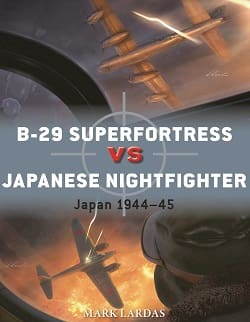
by Mark Lardas
Softcover (7.25×9.75 inches). 80 pages. 2025.
Subtitle: Japan 1944-45
My late father-in-law flew on photo recon B-29s over Japan in WWII. His joke was: “What’s the difference between flying a bombing mission and a photo recon mission?”
“On a bombing mission, you fly in once, drop bombs, and get the hell out. For photo recon, you fly multiple grid lines, so if they don’t get you the first line, they try, try again.”
He survived, but once his plane belly-landed on a beach either on or near Guam and a second time, the plane made a forced water landing in the middle of the Pacific Ocean. A PBY deviated from its flight path to pick up the crew and continued on to Australia. Two days later, he was back on a plane bound for Guam.
In any case, this volume in the series covers the technical specifications, crew and pilot training, and operational doctrine for both sides. For the US it’s the B-29, which went through a series of problems as it was rushed into service. For the Japanese, the planes covered are the Kawasaki Ki-45 Toryu (“Destroyer”) and the Nakajima J1N1-C Gekko (“Moonlight”).
What’s interesting was that the B-29 was faster (348mph maximum speed) than the Ki-45 (335.5mph) and J1N1 (315mph) (p62). Of more import, the Japanese did not have a centralized fighter command to direct defenses, nightfighter aircraft were few in number, Japanese radar was not as advanced as the US and European models, and pilot training was truncated. Production of Ki-45s and J1N1s ended in December 1944 and newer planes were not replacing them (p74).
Roughly one B-29 was shot down for every two Japanese nightfighters aloft, which sounds pretty grim except for the few nightfighter numbers and even fewer that could fly — roughly one-third to one-half of the planes didn’t fly for one reason or another (p76).
The booklet contains 53 black and white photos, three color photos, two black and white illustrations, one color map, nine color illustrations, one color two-page action illustration, and six aircraft color camouflage profiles (three B-29 and three Ki-45 — side, bottom, and front views).
Of the 3,970 B-29s built, 22 are still in existence (two in flyable condition). Only one Ki-45 and one J1N1 are still in existence — both in the Smithsonian Museum.
Enjoyed it.
— Reviewed by Russ Lockwood