.
.
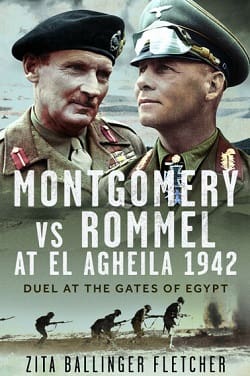
by Zita Ballinger Fletcher.
Hardback (6.4×9.5 inches). 284 pages. 2025.
Subtitle: Duel at the Gates of Egypt
The title has almost nothing to do with the actual text. El Agheila isn’t even reached until page 156 and even then the battle is described in general terms. Mostly, it was less a battle than a rearguard. Rommel sent the Italian infantry rearward to establish an alternate defensive line at Buerat while preparing the German forces to retreat. That’s when Monty attacked.
The bulk of the book is a psychological analysis of Montgomery and Rommel, starting with bios of them growing up in childhood. Eventually, Rommel shows up in North Africa and works his tactical magic to outfox the British and reach El Alamein. Enter Montgomery and British victory and the thousand mile plus chase across the desert.
Many books portray Montgomery as overly cautious. This one portrays him as a master of discerning Rommel’s tendencies and then exploiting those tendencies against Rommel.
Rommel’s relative ineffectiveness after losing at El Alamein results from disillusionment at being abandoned — few supplies, few reinforcements, and most of all, political disregard for his troops. Ordered to stand and slug it out, Rommel balked and retreated to save as many of his troops as possible. For this, he was shunned by Hitler, Mussolini, and the rest of the high command.
Monty drove his men forward all the quicker, even rashly, to keep Rommel retreating. At El Agheila, the chase ended for a while as both commanders regrouped and both headed off for conferences — Rommel to Germany and Monty to Cairo.
The same stand and slug it out order when Rommel fixed his defense at El Agheila resulted in the same response — retreat to save his troops and fight another day. Here, it was even worse, for he had lost faith in Germany victory after El Alamein.
The resumption of the British offensive hit rearguards that soon sped back to Buerat and then farther westward.
The book contains 35 black and white photos and three rudimentary black and white maps without scales.
As a narrative of the Battle of El Agheila, this falls far short of being useful for any scenario for the tabletop. As an examination of what made Montgomery and Rommel tick, this offers excellent analysis. It sometimes drifts into a bit of hyperbole about the desert — as if it was an entity — favoring Rommel, but otherwise is a nice, fast, well-written read.
Enjoyed it.
— Reviewed by Russ Lockwood