.
.
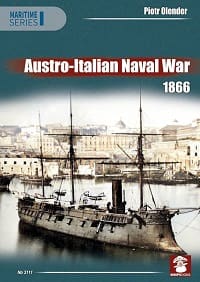
by Piotr Olender.
Softcover (8.3×11.8 inches). 182 pages. 2025.
You don’t often think of Austria being a naval power, but a 19th Century navy it had and was based at Pola on the Adriatic Sea. The Italians, as you’d expect, had a bigger navy, in part because it had a lot more maritime trade than Austria.
The Austro-Italian War started because of the Austro-Prussian War. Italy had signed a pact with Prussia and declared war on Austria in an effort to reclaim former Italian territories such as Venice.
The book details the developments in naval technology at the time as wooden ships gave way to ironclads. Even as wind transitioned to steam, paddlewheels gave way to propellers, and armor plated the sides of the ships.
At this exact time, cannon tech lagged behind armor tech, so some ironclads were also fitted with rams — just like ancient triremes — although powered by steam power, not human power. You get a full spec-heavy account of virtually each ship along with a discussion of tactics with the weaponry involved.
When Italian Army operations failed, the Italian Navy was sent to conquer the island of Lissa in the Adriatic Sea. The Austrians at first thought it was an attack on Venice, but soon discovered the offensive aimed at capturing Lissa. The two navies clashed at the island.
The Battle of Lissa on July 20, 1866 is described in exquisite detail, including analyzing the Italian command and control problems and the hesitation to commit its wooden ships against the Austrian ironclad ships, whereas the Austrian used their wooden ships to delay some Italian ironclads. And in a moment of something like insanity, the Italian C-in-C changed flagships just before the battle and sowed considerable confusion among his captains (p113).
The booklet contains 134 black and white photos, 94 black and white illustrations, 17 black and white maps, and 18 black and white ship drawings.
From war plans to OOBs, this booklet has all that you need to create a small naval campaign in the Adriatic along with your ironclad rules of choice. Well done.
Enjoyed it.
— Reviewed by Russ Lockwood