.
.
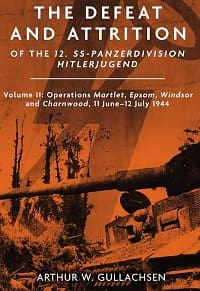
by Arthur W. Gullachsen.
Hardback (6.3×9.3 inches). 375 pages. 2025.
Subtitle: Volume II: Operations Martlet, Epsom, Windsor and Charnwood 11 June – 12 July 1944
The 12SS Panzer Division HitlerJugend (HJ) slotted into the German defense line around Caen after D-Day. Relentless British artillery, naval, and air bombardments basically shelled the division to relative oblivion as the British infantry and armor pushed towards Caen.
HJ gave a good account of itself despite being severely outnumbered and with limited supplies, artillery shell shortages, and almost no reinforcements reaching them during successive British offensives. The no retreat rule imposed by Berlin didn’t help either. The minimal Luftwaffe support, limited to some night bombings and one daylight effort, failed in the face of Allied air superiority.
Day by day, and virtually battalion by battalion in village after village, the HJ’s actions receive considerable tactical examination. Desperate fighting, local counterattacks, and chaotic command and control highlight the HJ’s month defending against British and Canadian attacks.
Much is made of the Allied artillery that saturated German defense lines and pulverized counterattacks. Ample shell supplies afforded the luxury of calling in artillery in whirlwind bombardments as well as general harassing fire. It all resulted in escalating German casualties that were not replaced.
By June 24, companies were down to under 100 men, and some, notably the 1st company in SS PanzerGrenadier Regiment 26 was down to 22 men (p104). The HJ resorted to combing out the rear areas to provide more infantry. Yet the attrition continued.
By July, I Bttn of PzG Regt 26 was down to six officers, 35 NCOs, and 259 soldiers while the II Bttn was down to five officers, 16 NCOs, and 136 soldiers. Considering that a battalion was supposed to be roughly 800 men, those are significant losses.
Furthermore, it was down to two or three of each heavy weapon: 75mm AT gun, 88mm AA/AT gun, 75mm infantry howitzer, and 150mm infantry howitzer. The regiment was assigned a 5.5km frontage, or roughly about twice what a full regiment was supposed to defend (p252).
It does make you think about unit losses versus battlefield viability, especially if you think about a variety of WWII wargame rules. Companies that attack when only at 25% of book TO&E strength makes you wonder.
A typo: STuGs were not “open-topped” (p167).
The book contains 40 black and white photos and 13 black and white maps (rather helpfully, most with battalion placements).
As the book often delves into individual German companies and with armor even down to platoon level, you get a considerable amount of tactical detail within the text. It’s workmanlike prose sends units here and there, which can get a bit overwhelming, especially when trying to remember all the British and Canadian regimental acronyms and numerous French villages. But that’s what a good unit history will do and this is indeed a good one.
Enjoyed it.
— Reviewed by Russ Lockwood