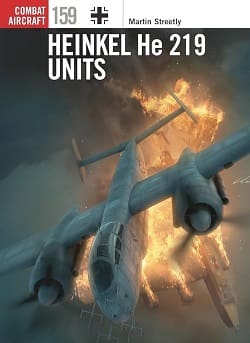
by Martin Streetly
Softcover (7.25×9.75 inches). 96 pages. 2026.
The HE-219 started design life as a fast bomber or heavy fighter, but as that was deemed unnecessary, it was redeveloped as a purpose-built night fighter. The British night bombers started raining bombs on German cities and something other than converted twin-engine fighters was needed.
Except the head of the Luftwaffe, Milch, took a disliking to the design and did everything he could to kill the project. Yet, it persevered and the first prototype flew on Nov. 6, 1942 (p9) with the second prototype flying on Jan. 10, 1943 (p10). Despite Milch’s efforts, the ninth prototype flew the first mission and shot down three British bombers on June 11-12, 1943 (p12). That helped put it in production, although technical issues required updated designs.
With up to six 20mm/30mm cannons, it had the firepower to take down four-engine bombers. Radar helped vector it into the bomber stream. It also included ejector seats for both crew members that were used with varying success.
The text doesn’t make for the most scintillating read, as it’s comprehensive, if repetitive. Log entries, I imagine, peppered with first-person accounts.
The booklet contains 54 black and white photos, three color photos, one black and white illustration, one color illustration, and 20 color camouflage profiles of specific aircraft. A modeler will enjoy those.
About 70 HE-219s were captured at the end of WWII. Five were sent to UK and three to US for testing. Of the eight, one HE-219 survives as a museum aircraft in the Udvar-Hazy Museum extension of the Smithsonian.
Enjoyed it.
— Reviewed by Russ Lockwood