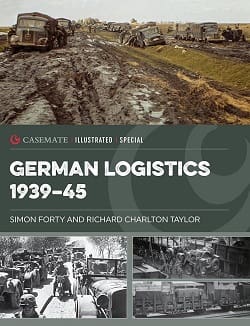
by Simon Forty and Richard Charlton Taylor
Hardback (8.2×10.3 inches). 192 pages. 2025.
Subtitle: Casemate Illustrated Special
What a great topic!
While German logistics often get blamed for failures, you have to give the process credit for supplying all those troops across Europe throughout much of the war. The organizational detail needed to coordinate industry, transportation, and distribution was mostly effective given the distances, weather, and gradual loss of air superiority.
The quick version of industry to Army to Corps to Division is shown in diagrams, but the text reveals explanations of distances and delivery concerns. A railhead to an Army supply drop should be not more than 60 miles (p76). In the West, a Division supply drop was from 10 to 50 miles behind the front. In the USSR, the vast distances often meant distances of 100 miles (p72).
Cargo trucks could travel at 30 kilometers per hour (about 18mph) during daylight and half that at night. A day’s truck and trailer transport, including loading and unloading, averaged about 300km (186 miles). Animal-drawn wagons could travel 12 to 15 miles per day (p80). Adjust for weather and terrain and presumably aerial attacks.
A number of charts relate march speeds and distances. For example, troops can march 3mph over long distances while tanks drive 12mph. In a day, an infantry regiment requires 6,234 yards of road space and will generally average 10-15 miles per day without motor transport and double that with motor transport (p110-111).
As for Allied air attacks, Production head Speer estimated German industrial production loss of 20% to 30%. And on and on the statistics go.
One possible typo about reorganization: “At the end of January 1944, all units were deleted” (p70) but immediately notes units had new registration numbers “by January 29, 1945.” That 1944 may be 1945, otherwise all units were without new numbers for a year, which seems odd.
The book contains 215 black and white photos, eight color photos, four black and white illustrations, three black and white maps, four color maps, and 10 color diagrams. I didn’t count the tables and charts.
This book is so full of details, tables, and charts, anyone interested in how the Germans supplied all their troops across Europe will be enthralled with its numbers and explanations.
Enjoyed it.
— Reviewed by Russ Lockwood