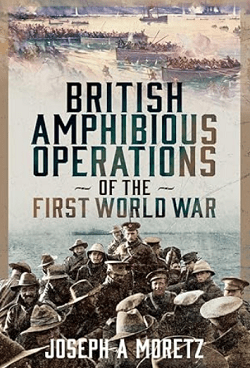
by Joseph A. Moretz.
Hardback (6.5×9.5 inches). 267 pages. 2025.
This covers three operations: Mesopotamia, Tanga (German East Africa), and Gallipoli. Each receives extensive analysis of what went right, but mostly what went wrong. Much has to do with the enemy opposition, of course, but failures in logistics factored heavily into repulses and defeats.
For example, the 1914 invasion at Tanga was made with little if any intel or recon of what the British forces were up against. Although initially successful, exploiting off the coast with inexperienced troops proved difficult. Much blame goes to the local porters, who fled at the first sign of gunfire. Besides the panic generated, logistics collapsed.
Although the British specialists in amphibious assault planning seemed proficient enough, the actual capacity of the military proved deficient. The local logistical infrastructure — railroads, canals, roads, and so on — was virtually non-existent in these three examples. Without such infrastructure, the troops could not exploit inland.
In Mesopotamia, for example, the river network provided a pathway towards further objectives, but the troop numbers and especially the small boats needed to move them and their supplies proved inadequate. Isolated at Kut, they withered and ultimately surrendered.
The book contains 11 black and white photos and three black and white illustrations. Alas, no maps are included. If the text mentions various towns and locations, you need maps (each with a scale) to help readers understand distances and advances.
As the British military concentrated on the Western Front in France, these peripheral operations suffered from a lack of the same level of logistical and troop support.
Enjoyed it.
— Reviewed by Russ Lockwood