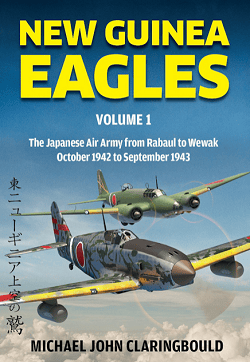
by Michael John Claringbould.
Softcover (6.9×9.9 inches). 208 pages. 2026.
Subtitle: The Japanese Air Army from Rabaul to Wewak October 1942 to September 1943
This offers up the Japanese perspective of WWII air operations in the Papua New Guinea area, with an offshoot to Guadalcanal and the Solomons. The key to all of Claringbould’s books resides in the extensive use of Japanese archives to offer an oft neglected perspective due to language and distance.
Besides the accuracy of Japanese airframes in operation and in repair, Claringbould compares and contrasts the aerial victory claims of both sides per operation. For example, after the air battles during the first Japanese convoy to Lae, the Americans claimed 84 kills and 36 probables. Actual Japanese losses were 16 (p57). Often the Japanese claims were little better, especially in reporting results of bombing Allied airfields. Overall, the overclaim rate was three to five times more than actual losses (p179).
In and among the recaps of air battles, you’ll find anecdotes worthy of wartime propaganda to justify such (over)claims. Like an old movie star tabloid newspaper, the fanciful air actions are supported by an iota of truth.
New to me were the engine problems of the Ki-61 Hien fighter. It uses a license-built BMW DB601a engine, but, and this is a big but, not the Bosch fuel-injection system. The Germans refused to allow that to be built. The Japanese workarounds never quite got it right. Hiens proved to be good aircraft when they worked, but they also suffered epidemic engine problems and considerable numbers of planes were lost during transfer flights. At one point, the Japanese commander grounded the entire fleet. Worse, the engines had to be shipped out of theater for repair because Papua New Guinea didn’t have major repair facilities for that engine. The Japanese had to rely on the Ki-43 Hayabusa fighter.
The book contains 66 black and white photos, two color photos, 42 color aircraft camouflage and markings illustrations, seven color maps, and four color illustrations.
Claringbould weaves action with explanatory context to give you a clear picture of Japanese aerial success that faded to parity and edged into failure. Plenty of scenarios can be pulled from these pages. The next volume covers October 1943 to April 1944. I look forward to it.
Enjoyed it.
— Reviewed by Russ Lockwood