.
.
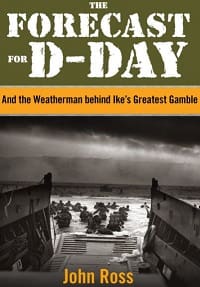
by John E. Ross.
Softcover (7.4×9.7 inches). 112 pages. 2014.
Subtitle: And the Weatherman Behind Ike’s Greatest Gamble
I didn’t take very many notes because there’s not much inside to employ on the tabletop. That said, you don’t think of forecasters as being part of the Army, but they played a crucial role.
The biographies of the various weathermen who advised Eisenhower proved interesting. This is supplemented by a Axis and Allied contest to gather weather data from ships, planes, and weather stations on Greenland and across Europe. Some of this I knew from previous books, and some, like clandestine weather service stations in occupied Europe I did not.
Also new was that the US Works Progress Administration (WPA) had a program to manually enter weather data from 1880-1933 on punch cards. A machine could sort these cards for types of weather and thus pave the way for forecasts (p26).
This led to the heart of the book — the crucial week before June 6. Besides a primer on weather patterns, the infighting between the weathermen sometimes gave conflicting forecasts. That the weathermen gave the OK for June 6, but not June 5, prompted Eisenhower to issue the one-day delay.
The book has 20 black and white photos and seven black and white maps.
In game terms, weather is usually some sort of die roll. Historically for 1944, there’s more to forecasting than a roll of a die.
Enjoyed it.
— Reviewed by Russ Lockwood