Promoting the study of military history through the art of tabletop miniature wargaming

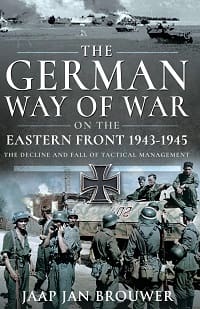
The German Way of War on the Eastern Front 1944-1945

.

.

by Jaap Jan Brouwer.

Hardback (6.5×9.5 inches). 209 pages. 2024.

Subtitle: The Decline and Fall of Tactical Management

This is the follow-up book to The German Way of War: A Lesson in Tactical Management (see the review in the 06/28/2024 AAR or up on hmgs.org) and chronicles the decline of German prowess as WWII wound down. The main cause was simple: not enough of everything, from manpower to supplies to logistical support.

As the German army suffered shortages of these three aspects, corners were cut in training, forces available for attacks and counter-attacks, and freedom of action. The result was a slow, steady decline in prowess. To that you can add that the enemy also became more proficient because their three aspects increased.

For example, ideally, the average German division could defend about 10km of frontage. By 1942, the average division had a 13km frontage, or about 30% more than ideal (p41). As the German divisions shrunk from losses and general attrition, the frontages only became larger.

There’s more to it than that simplification. Despite the growing disparity, man for man the Germans still held an advantage over all the Allies. Appendices explain the calculations that argue 6.07 Soviet soldiers fell for every German soldier in 1944. For the Western Front, that number was 1.53 Allied soldiers fell for every German soldier.

I found discussions about logistics to be interesting as well. The average German division needed 10,000 tons per month, which would take 1,200 Open 2-ton Blitz trucks. For all 130 or so divisions at the start of Barbarossa, that would mean 156,000 trucks. Given attrition, the bare minimum would be about 170,000 (p26). In 1941, the Germans produced 67,000 military vehicles of all types and in 1942 produced 96,000 of all types. In Stalingrad alone, they lost about 100,000 vehicles (p25). The point was that mechanization was only so much at the start of Barbarossa and declined as the years rolled by despite increasing production and scrounging throughout Europe.

A couple typos: The chart of German 1943 tank production lists six types of tanks, but contains only five bars (p30), although I suppose production could be “0” for the Pz 38(t). The chart refers to the Panther as “Panter.” The text usually refers to “Panthers.” This carries over to “Jagdpanter” (p105 and 107) when we know it as Jagdpanther.

The book contains 71 black and white photos and 14 black and white maps.

The book takes a holistic approach to defining the German decline in offensive and defensive projections. Given sufficient support, they could and did perform successful operations, but that advantage eventually faded at the strategic level and then the operational level until the tactical level declined as well.

Enjoyed it.

— Reviewed by Russ Lockwood

 

Share:

Article Categories
Recent Posts
Book Reviews

Arctic Front: Wehrmacht Im Kampf

. . by Wilhelm Hess. Translated by Linden Lyons. Softcover (6.0×9.0 inches). 232 pages. 2025 reprint of 2021 translation of 1956 book. Subtitle: The Advance of Mountain Corps Norway on Murmansk 1941 I am always up for a read of one of these 1950s Wehrmacht Im Kampf books. Written by

Read More »
Book Reviews

Wings Over The Fleet: British Naval Aircraft Since 1945

. . by James Jackson. Hardback (8.5×12.0 inches). 400 pages. 2025. This nice, big compilation of British aircraft takes readers into the design and development of aircraft from propeller to jets. Each chapter is generally a type of aircraft: strike, interceptor, and so on. You’ll also find chapters on helicopters,

Read More »
Book Reviews

Jewels and Jackboots: Hitler’s British Channel Islands

. . by John Nettles. Softcover (5.1×7.8 inches). 337 pages. 2024 reprint of 2013 book. The author is better known as a Midsomer Murders TV detective, but when shooting Bergerac in the Channel Islands, he became fascinated with the islands’ history, especially the period from 1940 to 1945 when the

Read More »
Secret Link

Contact an Individual

Please select the individual you wish to email.

Contact HMGS

Please only use this form if you can’t use one of the other Contact Us links.

Contact Outreach

Please only use this form to communicate with the Outreach volunteers.

Contact Membership support

Please only use this form to communicate with the Membership volunteers.

Contact Information Technology

Please only use this form to communicate with the Information Technology volunteers.

Contact Fall In! Exhibitors Manager

Please only use this form to communicate with the Fall In! volunteers.

Contact Fall In! Events Manager

Please only use this form to communicate with the Fall In! volunteers.

Contact Fall In!

Please only use this form to communicate with the Fall In! volunteers.

Contact Cold Wars Exhibitor Manager

Please only use this form to communicate with the Cold Wars volunteers.

Contact Cold Wars Events Manager

Please only use this form to communicate with the Cold Wars volunteers.

Contact Cold Wars

Please only use this form to communicate with the Cold Wars team.

Contact Historicon Exhibitors Manager

Please only use this form to communicate with the Historicon Exhibitors Manager.

Contact Historicon Events

Please only use this form to communicate with the Historicon Events Manager.

Contact Historicon

Please only use this form to communicate with the Historicon team.

Contact Convention Operations

Please only use this form to communicate with the Convention Operations volunteers.

Contact Marketing & Communications

Please only use this form to communicate with the Marketing & Communications volunteers.

Report a Website Issue