.
.
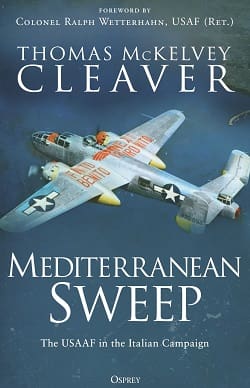
by Thomas McKelvey Cleaver.
Hardback (6.3×9.5 inches). 328 pages. 2025.
If you enjoyed Clean Sweep: VIII Fighter Command Against the Luftwaffe 1943-1945 about Allied air operations on the Western Front, you’re going to enjoy this one, too. This also takes the US perspective with plenty of first-person pilot accounts of WWII missions and actions.
Oddly enough, the book starts with Allied negotiations with Italians over Italy’s surrender. It’s a relatively succinct diplomatic dance that only ended with the invasion of Salerno and Messina (around p67).
The Luftwaffe in mid-1943 was still a dangerous opponent able to launch bombing raids. For example, 105 JU-88 bombers raided the port of Bari and sunk 17 ships and damaged eight more. It also exposed a British merchant ship carrying mustard gas bombs (p114-117).
Allied pilot claims are always high, but the USAAF eventually wrested control of the skies. The Italian air force is almost never mentioned, but Mount Vesuvius erupted and rained rocks and ash down on US B-25s at Pompeii air base — 88 bombers were destroyed (p117-120).
Fun fact: USAAF maintenance crews often restored wrecked German planes so aircraft crews could practice against the actual enemy planes (p98).
Funner Fact: The CO of a bomber group was so tired of P-38s from the fighter group missing rendezvous, he hopped in a ME-109G and “attacked” the fighter group’s airfield by buzzing and firing all around. Funny, the P-38s supposedly never missed another rendezvous (p95).
The first-person pilot stories often repeat as that is the nature of air-to-air dogfighting, but the anomalies draw you onward. For example, Lt. Brown flew as a wingman so close to his leader that his bullets were going over the leader’s wing while strafing. Told to move over, Lt Brown did and ran his P-47 into the top of the only 100-foot-long pine tree in the area. With a smashed canopy and sawdust and wood chips in the cockpit, he followed his leader’s instructions and flew back to base, landing safely even without hydraulics. Brown announced he had used up his luck and he never flew again and the plane never flew again either (p167-168).
You even get Joseph Heller info, who was a combat navigator on B-25s in Italy during WWII. After the war, he went on to write Catch 22.
Finally, the most humorous pilot nickname was bestowed on a P-47 flight leader named Hare – they called him “Wabbit” (p217). If you’re not sure why that’s funny, you’ve never gone hunting with Elmer.
The book contains 18 black and white photos and two black and white maps.
As I noted before, the air combats can get repetitive, but the exceptions prove most entertaining and keep you reading.
Enjoyed it.
— Reviewed by Russ Lockwood