.
.
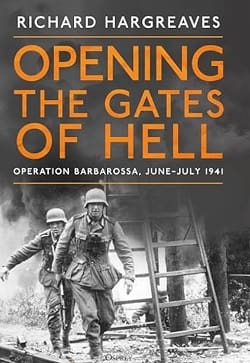
by Richard Hargreaves.
Hardback (6.3×9.5 inches). 504 pages. 2025.
Subtitle: Operation Barbarossa June-July 1941
This well-researched tome focuses on the build-up at the border between Germany and the Soviet Union and the two months after the invasion of the USSR began on June 22, 1941. At least that’s how it starts…
It’s pretty apparent Stalin feared the German armed forces. Despite all indications, spy reports, and border violations by Luftwaffe recon aircraft, he forbade any measures that might cause a provocation. First-person accounts by German and Soviet commanders and soldiers explain the increasing tension along the border and the Soviet front-line pre-invasion frustration at not being able to even shoot AA at the Luftwaffe, must less engage in aerial combat.
A quote from the Swedish Ambassador puts the German build-up in perspective. “We face either a battle of global significance between the Third Reich and the Soviet Empire, or the most gigantic case of blackmail in world history.” (p50)
Then comes the actual start of combat operations with devastating surprise attacks and mostly disjointed defense efforts. The push of the panzers, defense of Brest fortress, air superiority, and the rest get a fresh look.
The text weaves first-person accounts into a narrative instead of dropping excerpts — a much appreciated style that emphasizes readability. Sure, some excerpts are set apart, but not the usual overwhelming number that interrupt the narrative and seem to be the rage today. Books are more than dumping excerpts on a page. Kudos to Hargreaves for creating satisfying prose.
Yet, somewhere around the halfway point, details about atrocities and war crimes perpetuated by the Soviets, the Poles, and the Baltic State populace come to the forefront. Or, at least they seem to overwhelm combat operations. The Soviets slaughtered inmates in prisons before the Germans could reach the prison. The Baltic populace slaughtered the local Communists that failed to evacuate fast enough. And everybody took vengeance against the Jews for a variety of perceived transgressions. Such horrors become a bit much to digest, even though they are important to document.
Some points stick out. German infantry usually marched about 20 miles per day. In early July 1941, the Bulgarian ambassador brought a peace offer from Stalin — but it was a ruse to buy time (p421). After one month, the German 29th Motorized Infantry Division was pulled from combat for a refit after losing 700 dead and 1,900 wounded and with only 12 tanks left operational (p435). Over the radio, German propaganda broadcast a portion of Lizst’s Les Preludes before the reading of the war news about the Eastern Front (p108). Who knew Barbarossa had a theme song?
The book contains 19 black and white photos and five black and white maps.
One odd mention: the 11th Panzer Division was nicknamed the “Ghost Division” (p61). I thought that was the 7th Panzer, but maybe the 11th also received the nickname for its rapid infiltration of Soviet defenses and even faster exploitation.
This well-written examination of the first month of Operation Barbarossa examines the well-executed plan of the Germans, the chaos and confusion of the Soviets, and the brutality of populations primed for vengeance by oppressive rule. Well done.
Enjoyed it.
— Reviewed by Russ Lockwood