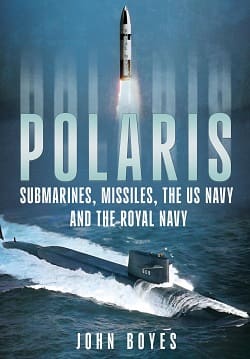
.
.
by John Boyes.
Hardback (6.5×9.5 inches). 398 pages. 2025.
I’m normally not that fond of Cold War missile technology, but I became entranced with this mixed history of ballistic missiles from the V-2 on, development of submarine missiles systems, and the development of nuclear warheads.
The US reverse engineered captured V-1 rockets. Republic-Ford came out with the JetBomb 2 (JB-2) Loon that would have been used in the invasion of Japan. The company delivered 1,391 JB-2s to the USAAF by Sep 15, 1945 along with some to the USN for ship and sub launch testing (p49).
The Germans built a prototype submarine launching system for V-2 rockets called Prufstand XII, but so late in WWII they couldn’t test it properly. The Western Allies captured much of the German rocket development team and materials and that jumpstarted efforts to field US rocketry in general.
However, post-war, the USAF refused to work with the USN on joint development of solid fuel missile to replace liquid fuel missiles. A visiting UK Lord Mountbatten suggested to a frustrated Adm. Rickover that the USN borrow a Royal Navy “observer” with missile experience (p69).
Besides the battle with the USAF over which service gets control over nuclear weaponry, the USN internecine infighting proved quite entertaining. Things never do seem to change when it involves internal politics and program funding.
The new rocket, launching system, and submarine technology was developed and tested, setbacks overcome, and the US began to build nuclear missile-equipped submarines. Construction and deployment of all the Polaris-equipped subs takes up much of the rest of the book.
The US also had a fair share of mishaps while developing the technology.
Incidentally, Adm. Rickover wanted to sue Revell and Renwal plastic model companies when they brought out their USS Nautilus model with full interiors (p88). He claimed the models gave the Soviets free intelligence. Nowadays, you can visit the USN Submarine Museum in Groton, CT, (see the 5/20/2023 AAR for my visit) and walk onto and in the actual USS Nautilus, the world’s first nuclear-powered submarine.
The book has a part II with the UK Royal Navy building and fielding four submarines with Polaris missiles. On the one hand, it seems a bit bolted on — might have been better off as a separate book. On the other hand, RN development of sub-launched nuclear missiles and submarines minimized duplication of US effort.
The RN program suffered a number of problems, including finding hull cracks in the second sub hull a week after launching, numerous collisions and groundings, and yet more failed launches. The US and UK had a touchy relationship when it came to sharing information.
Couple minor typos: “resistant to mould and mildew” (p165) should be “mold” and duplicate sentences (p100).
The book contains 67 black and white photos, 58 black and white illustrations, and three black and white maps.
An informative book, of course, but a surprisingly interesting one as well.
Enjoyed it.
— Reviewed by Russ Lockwood