.
.
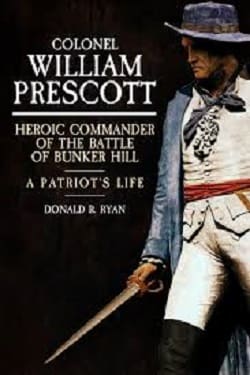
by Donald R. Ryan.
Hardback (6.3×9.3 inches). 260 pages. 2025.
Subtitle: Heroic Commander of the Battle of Bunker Hill
This biography paints a positive picture of the exploits of William Prescott at the outset of the American Revolution. In charge of a militia unit, he was put in command of the American militia that fortified Breed’s Hill and stood against the British. The battle has come down in history as Bunker Hill, the slightly larger hill behind Breed’s Hill, but by any name you wish, Prescott proved a brave and capable commander.
Besides his early life, he tried to answer the call at Lexington and Concord, but the 20-mile hike took a while and by that time, the British had withdrawn back to Boston. Nonetheless, he was assigned to Charlestown area with Bunker Hill.
One factoid I was unaware of was that the Americans started digging at night without a good idea of the lay of the land. A discussion about where to site the redoubt ended up at Breed’s Hill in advance of Bunker Hill. A thin line of troops bent back and then extended to the Mystic River, with a series of obstructions in front. These were later reinforced.
The battle is well told, including Prescott urging his troops to stand fast in the face of less than effective British ship bombardments. The British attacks and repulses, the lack of apertures for American cannon, the initial lack of British cannon, the slow exhaustion of American powder, and lack of speed at getting more powder all play out in detail.
Post battle, Prescott served around New York City on Governour’s Island and then at the Battle of Saratoga (although apparently not in the fighting), but ultimately left service to run his farm. He later came back to serve again.
The book contains three black and white photos, 12 black and white illustrations, and one period black and white map. I would have liked a bigger and better Bunker Hill map as well as a detailed OOB, but this is a biography, not a book about the battle.
A nit: I also find the intrusion of authors into the historical text a bit annoying. If you want to talk about interacting with park rangers, historians, librarians, and other experts, not to mention car trips with the wife, please put that in Acknowledgements or at best an Appendix. Such interruptions are fine for a friendly blog or AAR, but I find it off-putting for a scholarly book — and make no mistake, he put in the research big time.
An interesting point: “Would the outcome of the day have been different if the redoubt been built on Bunker Hill?” (p86). I immediately screamed, “Wargame!” Sure enough, Ryan mentions that game theory could examine decision making (p118). FYI: The British casualty rate was about 45% while the American casualty rate was about 25% to 30%. Hmmm. May have to consider the morale consequences of high casualties.
Anyway, we owe Prescott a big thanks for his efforts that day. And he is still important today — at the HMGS Historicon 2025 convention, a 25mm Prescott miniature figure was given out to attendees while supplies lasted. Now I know the history behind the figure.
Enjoyed it.
— Reviewed by Russ Lockwood