.
.
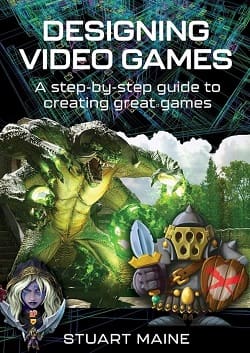
by Stuart Maine.
Hardback (9.6×11.9 inches). 215 pages. 2025.
Subtitile: A Step-by-Step Guide to Creating Great Games
The author 27-year (p15 — or in a back cover typo 28-year) track record as a video game designer merits a close read by wannabe designers of video games or paper games.
What astounded me was that more than 14,000 computer games were released on Steam in 2023 and something called Itch.io had over 200,000 games by 2019 (p65). So, how do you make your game stand out? Read on about creating content, adding human psychology to game conditions, and appealing to the nine types of gamers.
I was intrigued by the discussion of puzzles vs problems in game play. It initially sounded the same to me, but to advance in a game, Puzzles require one (or sometimes more) specific solutions while Problems can be solved in multiple ways, including ignoring them.
The same top-down design decisions also apply to zero-sum (simplest is one player gains resources while another loses them) and win-win (all players can increase resources) approaches.
There are far more examples. The flip side of this is that most of these considerations are overviews. The nuts and bolts are a bit skimpy at times, but enough is mentioned to at least get the prospective designer thinking about what to include or not include to create a great game.
Other aspects touched include “opportunity costs” — the time, effort, and money required when adding features — and the “edge cases” — consequences that must be tested arising when adding options. The latter is a bugaboo in miniatures rules. If you add “x” mechanic, then y, z, aa, bb, cc, and more are affected and must be ruthlessly playtested to see if it’s a game breaker.
In terms of effort, 20% of a designer’s time will be spent on ideas and prototyping, 50% on creating content and coding, and 30% on playtesting and debugging (p90).
The book contains 102 color images, with the vast majority being in game screenshots from a wide variety of video games.
Starting with the basics, including motivations and ideas, through the prototyping, coding, playtesting, and marketing stages, he does indeed offer step by step considerations about creating video games. Yet I found the steps also applicable to boardgames and miniatures rules. Well done!
Enjoyed it.
— Reviewed by Russ Lockwood