.
.
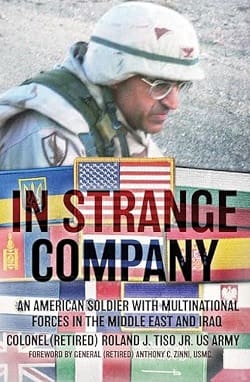
by Col. Roland J. Tiso jr (Ret).
Hardback (6.5×9.5 inches). 401 pages. 2023.
Subtitle: An American Soldier With Multinational Forces in the Middle East and Iraq
This memoir covers Tiso’s assignment to US Central Command for the Middle East as well as direct liaison to a Multinational Division consisting of Ukrainians, Poles, Spanish, Hondurans, El Salvadorans, Fijians, and others, including creating an Iraqi battalion.
On the one hand, you’re rewarded with an in-depth examination of his efforts to placate all these non-US interests while trying to get them to patrol and stabilize the country. The various competing national instructions complicates efforts, as does trying to set up a logistical supply line that will provide everything the US promised to each contingent. Sorting all that out dominated his time, from attending formal (National holiday) to informal (goat grab) ceremonies to prodding patrol actions to actually going on patrol.
On the other, his tone is relentlessly optimistic, which masks what must have been utter frustration. Every officer he meets is a hard-working, excellent soldier, well, except for the Spanish commander, who seemed to operate under national restrictions in the deployment of his troops, and the Iraqi recruits, who seemed in no hurry to learn military discipline. The plan called for 10 divisions of Iraqi troops but he had enough problems standing up a battalion.
Tiso offers considerable praise to the Ukrainians and Poles, who often veered from standard US procedures when it came to patrolling and closing the border with Iran.
He does note that all his efforts in the mid to late 1990s to plan for Operation Iraqi Freedom was ignored, the force necessary to stabilize a conquered Iraq was shortchanged, and political decisions to dissolve the Iraqi Army proved shortsighted. The result was an escalating series of insurgent attacks and border infiltration by Iranians. His service time came to an end and he departed back to the US, laden with accolades from non-US contingents and good relations with most of the allied commanders.
The book contains nine black and white photos and three black and white maps.
If you are looking for a terrific account of liaison soldiering, with all the political sensitivities required, here’s your book. Just understand it comes across a little too diplomatic and rosy.
Enjoyed it.
— Reviewed by Russ Lockwood