.
.
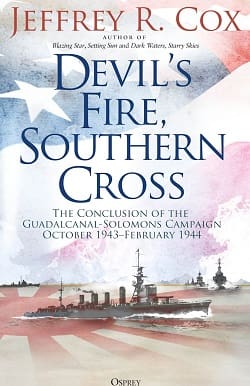
by Jeffrey R. Cox.
Hardback (6.3×9.5 inches). 502 pages. 2025.
Subtitle: The Conclusion of the Guadalcanal-Solomons Campaign October 1943-February 1944
In movies, when a character faces the camera and talks to the audience, it’s called breaking the fourth wall. This book breaks the fourth wall with the readers and it is exceptionally distracting.
It started early and I shrugged the asides off until the following sentence compared the toughness of the B-17 and B-24: The B-17 could “lose all four engines, both wings, the vertical stabilizer, the hull, the hydraulics, the radio, the air conditioning, the cigarette lighter, and the lower lumbar support and still return safely.” (p24)
If that had been a direct quote from a crewman, all’s well. As an aside, it’s over the top — and it never stops, appearing on just about every other page, if not every page. Some others:
“A convoy of that many transports is not out there for fun. Well, it could be, but probably not, and it was not the reason here.” (p49)
“One shell even struck Admiral Merrill’s flagship Montpelier, drenching the exposed gunners and wrecking his favorite typewriter. The bastards.” (p51)
A couple of these scattered through the book would be fine, but page after page of these, including, and I kid you not, “wisecracking” references to Monty Python, Buckaroo Banzai, Lord of the Rings, Smokey and the Bandit, and other cultural touchstones reduce the otherwise fine prose to distraction. No wise. Just cracking the flow of the prose like the Silence forming a crack marring a smooth wall at the Eleventh Hour. See what I did there? My Dr. Who aside works just like his: not at all.
I don’t remember such dross in his previous books. I picked up another of Cox’s volumes, Blazing Star Setting Sun, and randomly read a dozen pages in the middle. Same attention to detail. Same analysis of quantity and quality of forces. Same riveting battle descriptions. Not a single distracting aside.
One typo: “headvictorious” (p153) needs a space.
The book contains 21 black and white photos and five black and white maps.
Did Cox get bored? Did an editor suggest punching up his prose with these distracting asides? Did he get distracted and write this while doom-scrolling on his phone? I have no idea but it backfired with me. Oh, I soldiered through the text, his top-notch research propelling me onward even as I cringed every other page.
Apparently, past results don’t indicate future performance. He doesn’t need such gimmicks to write fascinating and well-researched history. The dozen pages from that previous book brought me right into that history, action, and consequences.
This time, ties go to the author. Next time? Lose the asides. Stick with your excellent analysis and commentary.
Enjoyed it.
— Reviewed by Russ Lockwood