.
.
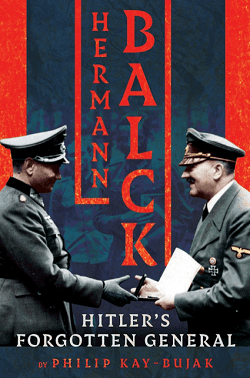
by Philip Kay-Bujak.
Hardback (6.4×9.5 inches). 340 pages. 2025.
To be clear, this biography discusses Gen. Balck, not the nuts and bolts of his battles. You’ll learn how he approached offensive and defensive battles and his style of command rather than which company or battalion moved where — although you’ll get overviews of the attacks and counter-attacks he formulated on the Western, Eastern, and Mediterranean fronts.
He proved a tough taskmaster, constantly traveling among his front-line units to see the terrain and dispositions for himself. He was fortunate in having competent chiefs of staffs to push his orders while he was visiting the front. He also paid attention to fielding a superb repair organization to keep his panzers operational. Add in a capacity to formulate plans on the fly and you begin to see why he progressed up the ranks of the Heer. During the mid-war period, within a year he went from commanding a division to commanding a corps, then an army, and then an army group.
Unfortunately, the book suffers from considerable typos: “Coco-Cola” (p69) instead of Coca-Cola; “butd” (p121) instead of but; “noon-wearable” (p132) instead of non-wearable; “brining” (p194) instead of bringing; in the text, the town was “Rodalben” (p225) but the map on the same page is Rodalbe; “formationcould” (p233) is missing a space; advance to Caucuses mountains in “1943” (p233) is probably 1942; “Novcember” (p236) should be November; and “his leadership Russia” (p262) likely should read “in Russia.” Rushed or sloppy — not sure which.
The book contains 31 black and white photos, one black and white illustration, and nine black and white maps.
It’s a good biography, especially when it contrasts and compares passages from Balck’s memoirs with other accounts to set the record straight. When finished, you’ll understand what makes Balck tick, including his strengths and weaknesses or personality.
Enjoyed it.
— Reviewed by Russ Lockwood