.
.
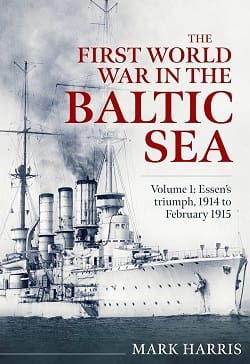
by Mark Harris.
Hardback (6.8×9.9 inches). 313 pages. 2025.
Subtitle: Volume 1: Essen’s Triumph 1914 to February 1915
The first thing to know is that Essen is Admiral Nicolay fon Essen, the Russian commander. His triumph was partially due to understanding the value of minelaying in German shipping lanes and then facing the decidedly “B” Team, and often the “C” Team, of the Germans.
The German Baltic Fleet didn’t have the fighting power, or even the prowess, of the “A” Team facing the British in the North Sea. Aging warships and under-trained officers and crews defined the German Baltic Fleet. The war barely started when, on August 26, 1914, the German cruiser Madgeburg ran aground in Russian waters. The key here was retrieving the German charts and cipher books. Copies were passed on to the British. Effective code cracking began soon thereafter.
The British also helped by sending tons of high-quality Welsh coal via Arkhangelsk just as stockpiled Russian supplies were getting low. The British even sent three submarines into the Baltic to be based in Russia. British and Russian submarines, although often laid up for repairs and maintenance, created problems for the Germans at times.
Finally, German arrogance and poor training contributed to poor performance and further losses, including other warships run aground. Minesweeping efforts proved ineffective as German cargo ships fell victims to mines — ironically, the Germans laid a minefield that claimed Russian ships first.
The retelling of the initial stages of the war deals with the various naval operations, but also how Russia and Germany dealt with Sweden — an important trading partner for both — as well as the abysmal winter weather that could and did swamp torpedoboat T.39 and T.50 so bad, their boilers were quenched (p136).
A few tabletop scenarios can be pulled from the text, aided by an Appendix with OOBs and ship specs. A campaign could be ginned up as well.
The book contains 65 black and white photos, one black and white illustration, 19 black and white maps, and four black and white diagrams.
The prose moves the war along, stopping to examine naval strategy and operations as well as battles, feints, and mine sinkings. Well done. I look forward to Volume 2.
Enjoyed it.
— Reviewed by Russ Lockwood