.
.
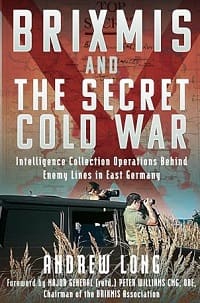
by Andrew Long.
Hardback (6.5×9.5 inches). 248 pages. 2025.
Subtitle: Intelligence Collection Operations Behind Enemy Lines in East Germany
Part of the post-war agreement among the US, USSR, France, and UK was the ability to send recon teams into each other’s territory in and around Berlin. This was often under the guise of attending ceremonies marking some military anniversary or another. This book covers the British operations — part covert spying and part overt spying from 1947 to 1990.
In the 1960s, the British usually ran three “tours” a week: a 36-hour tour, a 24-hour tour, and a local tour (p66). In the beginning, the British stayed in East German hotels and ate at restaurants. Later, the tours involved camping out overnight.
The British often traveled between Berlin and Potsdam, and often took the scenic route to gather intel on East German or Soviet troops movements, construction of bases and other defense works, and types of aircraft and other military equipment. Equipped with long-lens cameras and souped-up Mercedes and Range Rover vehicles, they drove the main and back roads to conduct surveillance missions.
It was all perfectly acceptable up to a point. When British troops snuck onto bases to photograph new equipment, that was crossing a line — if they got caught.
The Soviets or East Germans would tail the British and the cat and mouse game began as soon as the Berlin checkpoint was left behind. As the years rolled on, the tailing car became cars and sometimes armored vehicles. Ramming the British vehicles was not unheard of, and a couple Brits ended up dead and others in the hospital. Arresting the British soldiers was also popular, but usually a USSR commandant would be called and the Brits released.
A double-blind scenario comes to mind as the Stasi player tries to box in and capture a British team that had lost its initial tail in the countryside of East Germany.
One typo: “attempts to interrogate the very poorly corporal” (p171) needs something, but not sure what.
The book contains 40 black and white photos, 22 color photos, and four black and white maps.
One interesting anecdote: A USSR pilot crashed a Yak 28P aircraft (NATO codename Firebar) into the Stossensee (Havel Lake) on April 6, 1966 in the British sector of Berlin. The Brits refused Soviet entry to the salvage site and proceeded to secretly dismantle and analyze the aircraft and its systems before turning it and the bodies of the two airmen over to the USSR.
Enjoyed it.
— Reviewed by Russ Lockwood