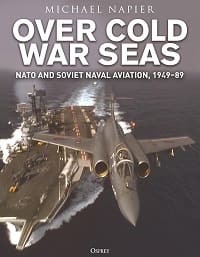
.
.
by Michael Napier.
Hardback (7.9×10.0 inches). 320 pages. 2025.
This overview covers the naval aviation element of the Cold War arms race from the formation of NATO in 1949 to the fall of the Berlin Wall in 1989. An additional chapter extends the timeline to the present day, albeit in a compressed manner.
Each of the main chapters covers a decade: 1950s, 1960, 1970s, and 1980s. It’s hardware intensive, summarizing the new planes, jets, and helicopters introduced at the time. Several first-person pilot accounts pepper the text.
One nice section summarizes the Cuban Missile Crisis, as the US Navy established a blockade around Cuba and flew a variety of patrol, recon, and anti-submarine warfare mission. Something new and interesting to me was the dropping of Practice Depth Charges on Soviet submarines — more than surveillance and less than a shooting war.
The Soviet transition from coastal naval force to blue-water navy in the 1970s and the NATO response offers a succinct examination of both sides’ capabilities and goals.
Although NATO (mostly US and UK, with Canada, France, and other countries forces) and the USSR dominate the book, a chapter covers the neutral countries at the time: Sweden, Finland, Spain, Ireland, Albania, and Yugoslavia.
The book contains 101 black and white photos and 126 color photos.
As the Cold War wasn’t a hot war, per se, the book mostly ignores any sort of clashes save for a couple here and there. Consider this an overview of capabilities and a solid jumping off point to investigate the era should you wish to consider WWIII scenarios.
Enjoyed it.
— Reviewed by Russ Lockwood