.
.
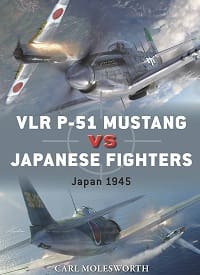
by Carl Molesworth.
Softcover (7.25×9.75 inches). 80 pages. 2025.
Subtitle: Japan 1945
This volume covers the aircraft and battles between the Very Long Range P-51 and several Japanese late-war fighters: Zeke, Jack, George, Frank, Tojo, Tony, and Ki-100 (no name) from April to August 1945.
Overviews of the design and development of the aircraft showcase specs and performance and lead into the ineptly-run Japanese early-warning system, rivalry of Japanese Army and Navy organizations, and relative experience superiority of the US pilots over Japanese pilots. For example, US pilot training was in excess of 200 hours versus Japanese pilot training of 60 to 70 hours (p48). Even then, the US turned out 193,440 pilots of all types in WWII, far more than the 46,000 Japanese pilots (p50).
One point that was new to me: 1945 Japanese organization. US is pretty simple: Four fighters make up a Flight, four Flights (16 fighters) make up a Squadron, and three squadrons make a Group. Japan transitioned from a Vee of three fighters per Flight to four fighters (p52). Also interesting was that Japanese Army and Navy apparently had two different fighter nomenclatures: the Army with a Shotai being a Flight and the Navy calling it a Chotai (p51).
The booklet contains 56 black and white photos, two color photos, two color maps, two black and white maps, one color two-page action illustration, two color diagrams of plane formations, six color profile illustrations (front, side, and top for P-51 and Ki-84 Frank), five half-page color illustrations of armament, and two color illustrations of cockpits (P-51 and Ki-44 Tony).
The booklet ends with a series of air battles that you can use to pull out a scenario or two.
Enjoyed it.
— Reviewed by Russ Lockwood