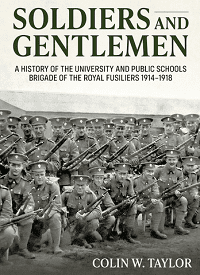
.
.
by Colin W. Taylor.
Softcover (6.7×9.7 inches). 537 pages. 2024.
Subtitle: A History of the University and Public School Brigade of the Royal Fusiliers 1914-1918
Britain raised four battalions, the 18th, 19th, 20th, and 21st, to create the “UPS” Brigade. Each recruited soldier was a student or a graduate from a university or public school — sort of like a higher education PALs battalion. It took a year to train them up and they were sent to France in November 1915. The 18th and 20th went to the 2nd Division and the other two to the 7th Division, so the Brigade was never deployed as a whole.
This was considered a “quiet” part of the Western Front, but the excellent descriptions of day-to-day trench life sees day after day of casualties from random barrages, No Man’s Land patrols, mines exploding, and sniper attacks. Indeed the descriptions become repetitious because the research behind the text examines every death, and I mean every death, of a UPS soldier. It’s the constant drip, drip, drip of attrition of trench warfare .
As overall British casualties mount, especially among low-level officers, the Army turned to these educated soldiers to replenish the officer ranks. The 18th, 19th, and 21st battalions were disbanded and any deemed unfit for commissions were used to replenish the ranks of other battalions (p204).
That left the 20th, which was transferred in 1916 to the Somme. These lads got to know the active front of the attack. Once again, each UPS soldier’s death is recorded among the horrors of trench warfare.
On February 1, 1918, the 20th was disbanded and its remaining troops sent to fill out other battalions (p433).
The book contains 68 black and white photos, 32 black and white illustrations, and 12 black and white maps.
Tremendous detail examines training to combat operations and all the losses that resulted. The gritty descriptions makes you wonder how any survived, but survive some did through the entire war. Impressive detail.
Enjoyed it.
— Reviewed by Russ Lockwood