.
.
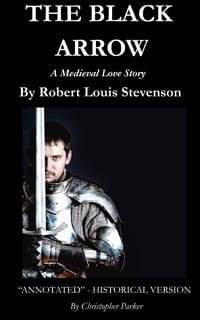
by Robert Louis Stevenson. Annotated by Chris Parker.
Softcover (6.0×9.0 inches). 271 pages. 2025 reprint of 1888 book.
Subtitle: Annotated Historical Edition
Robert Louis Stevenson is better known for Treasure Island than his next novel, The Black Arrow, which is set during the Wars of the Roses. The story follows a young man, Dick Shelton, as he tries to avenge his father’s death, reclaim his lands, and marry his sweetheart Joanna.
The plot of this historical novel works well enough and stands the test of time, but the prose … well, it’s hard to read at the start. First off, if you’ve read original material from the 19th Century, you’ll understand the verbose difference back then from today’s prose. Second, the general dialogue and conversations are written in a sort of high medieval, tongue-twisting patter. You’ll sometimes hear snippets of this in old black and white Hollywood movies. In the book, characters speak like this all the time.
So, I found it a tad difficult to get into the prose. After a while, my brain adapted. Yet, the next time I picked up the book, I had to re-adapt. To be fair, the introduction does warn you about the “Old English” prose.
What makes this different from a straight reprint is a number of annotations that define medieval words and characters.
Some of these I knew and some I didn’t. For example, “leper” (p73) I knew without looking at the note explaining leprosy and how medieval society feared and pitied lepers, while “spotted with golden gorse” (p59) baffled me. The note explains gorse was a shrub. Learn something new every day.
In addition, the book contains 32 public domain black and white illustrations paired to sections of the text. They range in quality, from the woodcut ship (not so much) to the Alehouse (cool).
The book contains a number of non-fatal layout typos where a line is truncated before reaching the right-hand side of the page. The prose continues without missing a beat.
The original story was serialized in Young Folks magazine between June 30, 1883 and October 20, 1883. RLS released the book version in 1888. According to Wikipedia, The Black Arrow, being in the public domain, has been republished many times, especially 2000-2008.
So, this is another version — call it an illustrated and annotated version. It’s not for everyone, but once you get used to the prose, it’s an engaging story.
Enjoyed it.
— Reviewed by Russ Lockwood