.
.
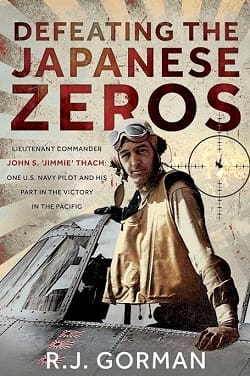
by R. J. Gorman.
Hardback (6.4×9.5 inches). 232 pages. 2025.
Subtitle: Lieutenant Commander John S. “Jimmie” Thach: One U.S. Navy Pilot and His Part in the Victory in the Pacific
Thach was a US Naval Academy graduate who when from communications on battleships to an aviator best known for inventing the Thach Weave as a way for two F4F Wildcats to defend against faster and more maneuverable Japanese Zeros. It’s basically a leader and wingman flying roughly parallel and switching places from time to time — especially if a Zero was on a tail. That way, as they switched, they lined up shots on Japanese Zeros tailing the other plane. Thach drilled his squadron in deflection shooting so well, they took the USN’s annual marksman award just prior to the war.
His squadron was at Midway, contributing to the US victory, and he later was sent to teach gunnery and the Thach Weave to new pilots. He was later transferred to run fighter operations just after the Marianas Turkey Shoot and helped set up defensive tactics versus kamikazes. This was called delousing where Hellcats stationed over picket ships would try and pick off the kamikazes before they reached the main US fleet.
These are the strongpoints of the book. The rest is mighty weak. To be kind, the prose is rudimentary at best. And while I might acknowledge the context, the descriptions of the Pacific War never lift above the mundane. Sorry, but because most HMGS members know WWII, this seems too general. If you’ve never read a book about the Pacific War, I’ll rescind that point. Yes, that’s harsh, but to my mind accurate.
Other bugaboos: Admiral Yamamoto wasn’t arrogant to attack the US at Pearl Harbor (p80), he made the best plan he could in a gamble to fulfill the Japanese strategy of causing enough US casualties to eventually negotiate the end of the war — before Japan ran out of oil and other natural resources.
The B-25 “could fly further than any plane designed to take off and land on an aircraft carrier” (p84). Er, no. It was modified for the Doolittle Raid to take off from a carrier, but never designed for that task and certainly not to land on a CV.
At Midway, the Japanese loaded “100lb torpedoes” (p120)? That’s probably some sort of typo. As I didn’t know what a torpedo weighed, I looked it up via several sources — about 1700-1800 pounds for Japanese Type 91 torpedoes delivered by air in 1941 and 1942.
The book contains 16 black and white photos.
So, this contains an excellent explanation of the two Thach tactics, and reproduces the original Midway report by Thach and Lt. Commander Best, but the rest seems rather general. No bibliography, but the footnotes makes it seem cobbled from mostly secondary source books.
— Reviewed by Russ Lockwood