.
.
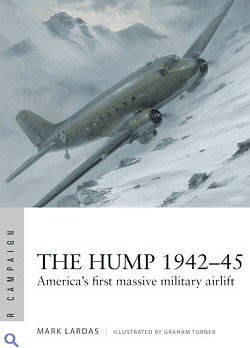
by Mark Lardas.
Softcover (7.25×9.75 inches). 96 pages. 2025.
Subtitle: America’s First Massive Military Airlift
The US agreed to provide arms, ammo, and equipment to China during WWII and there were two ways to get it there: The Burma Road and The Hump. The latter was an air route, the main southern path over jungle and the main northern path over the hills of the Himalayas. Either route was dangerous and this booklet concentrates on the northern route.
The strengths and weaknesses of the cargo aircraft, converted bomber aircraft, and fighters used by the US and Japan are discussed, as is the weather. Although Japanese fighter interception was rare, bad weather was not. Some of the planes were new and had teething problems — some aircraft were never found, lost presumably from mechanical failure. One plane didn’t have wing ventilation and could explode in mid air.
The primitive facilities and airfield infrastructure are also discussed. The US upgraded throughout the war. The Japanese not so much. While both sides believed the China-Burma-India theater a backwater, US logistics were better than the Japanese logistics.
One typo: “helped plots find airfield” (p59) should be pilots.
The booklet contains 54 black and white photos, 10 color photos, one black and white illustration, one black and white map, five color maps, three color diagrams, and three color two-page action illustrations.
Nice and succinct as an Osprey should be.
Enjoyed it.
— Reviewed by Russ Lockwood