.
.
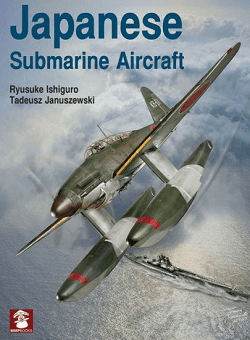
by Ryusuke Ishiguro and Tadeusz Januszewski.
Hardcover (8.5×12.0 inches). 176 pages. 2015.
On January 6, 1915, German U-boat U-12 carried a FF-29a seaplane on its deck towards the British coast. The U-boat submerged, the FF-29a took off and flew over the Kentish coast and harbors before flying back to its base in Zeebugge (Netherlands). The feat was not repeated.
Japan got seaplanes at the end of WWI and began experiments with creating submarines that could launch and recover planes. The first one was J-5 with a Yokosho E6Y1 seaplane in 1931.
Indeed, the first operational use of such a combination was on Dec 17, 1941 over Pearl Harbor for a recon flight. The mechanics successfully pulled the seaplane from a sealed deck hanger on submarine I-7, assembled it, and watched it fly to Pearl. The sub submerged and awaited its return, when it was disassembled and stored in the deck hanger. Other flights took place over harbors in Australia. Although significant sub-based flights faded, by the end of the war a plan was crafted to bomb and torpedo the Panama Canal locks. The war ended just before the operation was to commence.
The first bombing of continental US was on Sep 9, 1942 by a sub-launched seaplane that tried to start wildfires in Oregon. The rainy weather foiled the attack.
The book details the design, development, production, and operations of every Japanese sub-based seaplane, including variants. The biggest obstacle was time to assemble and disassemble the planes. While under five minute times were hit on dry land, the time at sea was closer to 45 minutes to an hour.
A few typos: “operation” (p31) needs a capital O; the production chart (p71) is one cell off for the Overall Total; “aircraft . ” (p113) has an extra space between the t and period; and “aircraft , ” (p116) has an extra space between the t and comma.
The book contains 134 black and white photos, four color photos, 19 black and white illustrations, one color illustration, seven color maps, 65 black and white 1/72 scale drawings, seven black and white 1/48 scale drawings, and 39 color aircraft profiles.
While sub-based seaplane missions didn’t make much of a difference in the scheme of the WWII’s war in the Pacific, the comprehensive nature of the book offers an interesting sidelight of WWII operations.
Enjoyed it.
— Reviewed by Russ Lockwood