.
.
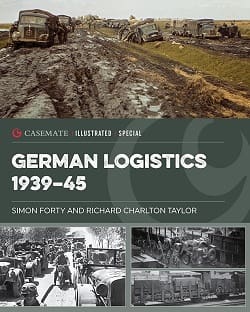
by Simon Forty and Richard Charlton Taylor.
Hardback (8.2×10.3 inches). 192 pages. 2025.
From production to delivery, this book provides an overview of land, sea, and air transport of supplies. German logistics, especially the train system, worked well in the West with its modern road and rail systems. In the East, eventually not so much.
A considerable number of tables, charts, and graphs accompanies the text, providing numerical weight to bolster analysis. Essentially, and despite the German penchant for detailed organization, logistics became robbing Peter to pay Paul.
For example, the WWII German rail system went to war with less locomotives and rolling stock than in WWI. And that was the main way to move war material from factory to the front line — to army-level depots and optimally to division railheads. From these, truck transport headed supplies to regiment and battalion depots.
The problem started with the trucks — not enough of them for all the formations. Capturing vehicles in occupied countries helped, but left the German Army and related Transport organizations with 2,000 different types of vehicles (p16). No wonder a shortage of spare parts became a problem throughout the war. The above only got worse with the increase in Allied bombing and strafing as the war progressed.
Never mind loss of factory production, so too were rail shipments reduced: while 900,000 freight cars were loaded for the week ending August 19, 1944, that went down to 700,000 cars in the week ended October 31, 1944, and down to 550,000 cars for week ending December 23, 1944, and down to 214,000 cars for week ending March 3, 1945 (p50).
Ignoring the trains needed to move raw materials (such as iron and coal) and sub-assemblies of finished products (engines, trousers, helmets, armor plating, pots, etc.), that had a significant impact on tactical military train loads: Type R trains needed 50 to 60 cars to haul 2,000 replacement troops; Type I trains needed 55 cars to haul 350 to 800 troops, 10 light and 10 heavy vehicles, 70 horses, and associated equipment (i.e. a full infantry battalion); Type Sp trains needed 33 cars to haul 20 medium tanks, personnel, and equipment (i.e. tank company); Type S train needed 30 to 35 cars to haul four to six Tiger tanks or similar Self-Propelled guns, six to eight Panther tanks, personnel, and equipment; and Type I trains needed 51 cars to haul 250 troops, 20 light and 20 heavy vehicles, and equipment (i.e. motorized infantry company)(p93).
One possible typo regarding a reorganization: after explaining the reorgs through November 1944, the text says “at the end of January 1944, all units were deleted…registered with new numbers by January 29, 1945” (p70). Seems like the “1944” should be “1945.”
The book contains 215 black and white photos, eight color photos, four black and white illustrations, three black and white maps, four color maps, 10 color diagrams, and a plethora of tables, charts, and graphs.
There’s plenty of nuts and bolts analysis and numbers of German supply within. If you want to understand the strengths, weaknesses, and operation of WWII German logistics, start with this excellent book. Well written, well chronicled, and well numbered. Well done!
Enjoyed it.
— Reviewed by Russ Lockwood