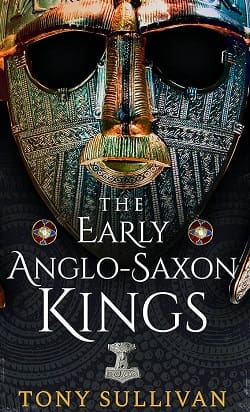
by Tony Sullivan
Softcover (6.3×9.2 inches). 219 pages. 2025 reprint of 2023 book.
The Angles and Saxons gradually conquered Roman Britain in the 5th and 6th Century AD, although the book cover part of the 7th Century as well as invasions by the Jutes and Frisians. The analysis of the period histories is especially well integrated within broader military and political events.
Chapter 4, Weapons and Warfare, discuss the warriors, equipment, and tactics of the time. The centrally-organized Roman armies gradually gave way to the local warband led by a chief. Of note in their histories, the Kinglne law code defined any unit of 35 warriors or more an “army” (p94). Most of them used spear and shield and while accounts may quote armies of 5.000 to 15,000 men, 5,000 to 6,000 would be an upper limit for the number of men in any force (p94).
King Arthur and his battles, especially Badon Hill, are discussed as part of the historical events. Depending on the interpretation of the various sources, that battle is recorded between the late 5th Century and early 6th century.
Of note, the most famous sword in history, Excalibur, is a named sword derived from Caliburn. Lesser known are the shield named Pridwen and spear Rhongomyant (p143). Indeed, various texts record the names of 200 swords (p100) of the period.
The book lacks an Index, a rather unconscionable omission. The text has a tab format gaffe (p82), “Ambrsosius” (p141) has a typo “s,” and “duel kingship” (p81) is probably “dual” — although given the considerable warfare of the period, dueling might be a possibility.
The book contains 35 black and white photos, 16 black and white maps, three black and white illustrations, and a number of helpful tables.
A new word for me: floruit. The web defines it as: the period during which a historical figure lived or worked. Learn something new every day.
It’s a book dense with information, so read carefully.
Enjoyed it.
— Reviewed by Russ Lockwood