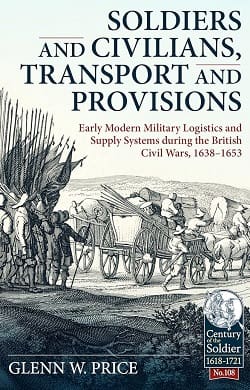
by Glenn W. Price
Hardback (6.3×9.5 inches). 256 pages. 2023.
Subtitle: Early Modern Military Logistics and Supply Systems During the British Civil Wars 1638-1653
My guess, and this is only a guess, is that the subtitle was the title of the author’s PhD thesis and the rhyming-ish title was a marketing decision. I may be selling the author short. Then again, I shudder when I find out a book is a repurposed PhD thesis. In this case, however, I was selling the author short.
While it certainly contains an academic style or prose, and far too many mentions of this historian or that researcher for a general book, the prose actually enters readable territory.
I don’t mean that to be condescending, only that I’ve read enough repurposed PhD studies that enter unreadable territory. So, kudos to the teaming of author and editor.
That said, this book is dense with information about how English Civil War-era armies obtained and dispersed supplies in four main chapters: land transportation, water transportation, recruitment, and provisioning.
Each details what was required and how it was and was not fulfilled. For example, in land transportation, an examination of wagons versus carts versus pack horses offers considerable insight on use and selection. A packhorse was better at carrying loads over difficult terrain and faster (25 miles to 33 miles per day) than wheeled vehicles, but only carried about 240 pounds per horse, or about 0.75 ton for six horses. The two-wheeled cart equivalent was 1.25 tons and the four-wheel wagon was 2 tons, but generally needed roads and was slower (20 miles to 25 miles per day) (p35).
Water transport was good at shipping bulk goods, but limited to sea ports and larger rivers. Boats often supplied besieged towns, assuming the besieging army didn’t fully interdict the river.
Infantry recruitment went from volunteers to conscription (called ‘impressment’), with the latter causing resentment and a corresponding increase in desertion from lack of pay and lack of food. Cavalry recruitment was often by invitation to lesser nobility, as more funds were needed to maintain a war horse.
Provisioning appeared to be the real problem with maintaining an army in the field. Besides resentment from forcible quartering of troops, ill-fed troops often confiscated food from the local farmers — including taking animals in situ or on the march and raiding cellars and other stored foodstuffs. The related topic of limited preparation and storage of flour for bread and the different types of “flour” for bread or porridge proved interesting.
The book contains 20 black and white period woodcuts or portions of woodcuts, four black and white maps, and one black and white photo.
I’d recommend reading through the extensive bibliography. Anyone contemplating an ECW wargame campaign will appreciate the effort that went into ferreting out data and the insight into how logistics shaped historical ECW campaigns. Well done.
Enjoyed it.
— Reviewed by Russ Lockwood