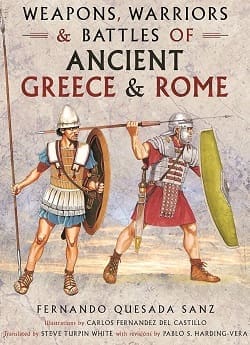
by Fernando Quesada Sanz.
Hardback (7.3×10.0 inches). 406 pages. 2025 reprint of a 2010 translation of a 2008 book.
I have a feeling this may have been a much larger form factor, for the type is tiny and the main text covers only 3.5 inches out of a 5.2-inch wide text layout — the difference is a margin often used for small photos and captions. I understand the use of white space in formatting, but I will continue to argue that leaving a third of the book pages empty while shrinking type into visual abuse territory is no way to format a book.
As I squinted my way through the text, the bad news is that I couldn’t read more than a chapter at a time. The good news is that each chapter is basically a self-contained unit.
And the book’s contents deserve better formatting. This sweeping overview of the militaries of ancient Greece and Rome, including forays into mercenaries, navies, and gladiators, offers excellent analysis of the broad operation of phalanxes, legions, and specialty troops.
I especially enjoyed the section on 5th Century BCE mercenary pay in relation to day-to-day expenses and the cost of armor and weapons (p97). Hence, mercenaries earned three to six obols per day, while subsistence food was two obols per day. A simple tunic costs 10 obols while a full set of armor costs 300 obols.
The analysis of bow and sling missile weapons (p118-122) is also interesting. A regular bow had a range of 175-200m while a composite bow went out to 300m. To my surprise, a sling was in the range of 200-300m. This was lower in actual combat, but provides a good guideline for your tabletop.
And on it goes through the ages, weapon by weapon and troop type by troop type, offering analysis of the strengths and weaknesses of various forces as battles played out across the Mediterranean area.
One typo: the end of a chapter (p238) is cut off mid-sentence and its conclusion is erroneously placed at the beginning of the next chapter.
The book contains 10 black and white photos, 23 black and white illustrations, 146 color photos, 92 color illustrations, and 18 color maps.
The contents are informative and the illustrations well crafted. It’s a shame the text is so squeezed when plenty of space is available to increase the font size. Get past or at least suffer the squinting and you’ll find a wide-ranging book on the classical ancient period of warfare.
Enjoyed it.
— Reviewed by Russ Lockwood