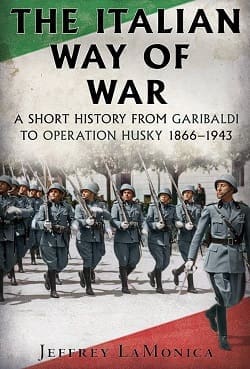
by Jeffrey LaMonica.
Hardback (6.4×9.5 inches). 176 pages. 2026.
Subtitle: A Short History from Garibaldi to Operation Husky 1866-1943
Despite the subtitle, the bulk of the book covers WWII (p56+). Indeed, Garibaldi barely receives a mention (p17-18) and minimal Italian military history prior to WWI (p18-26).
However, coverage of WWI, interwar, and WWII offer a succinct overview of Italian military fortes and foibles. In WWI, after the disaster of Caporetto, Italy opened up a number of specialty schools, including artillery, scouting, communication, and mortars, to improve performance. It even created Arditi — special assault troops not unlike German stormtroopers trained to infiltrate enemy lines, with Bersaglieri follow-up troops to secure gains and mop up bypassed enemy troops (p40).
Interwar Italian military adventures in Libya, Ethiopia, Spain, and Albania receive reasonable overviews of the various Italian shortcomings. Italy entered WWII undermanned, under-industrialized, and under-equipped. The country had to import 75% of its coal, 85% of its iron, and 100% of its petroleum (p94) — the latter point of some mirth considering how much oil was later discovered in Libya. The military result proved the fragility of the Army, although analysis showed flashes of brilliance despite the material and leadership handicaps.
One odd point: LaMonica refers to the 132nd and 133rd Divisions in North Africa. Who are those? Not being an OOB grognard, I had to look them up on the web. Ah. They were the far more familiar Ariete and Littorio divisions.
A couple style points: Oftentimes, a sentence begins with a written-out number followed by the number. For example, “Five thousand 5,000…” (p18). While correct to write out numbers at the start of a sentence, the number is unnecessary. You’ll find it elsewhere in the text (p31, 34, 41, etc). One non-fatal typo: “refit old” (p47) has an extra space.
The book contains 17 black and white photos, 11 black and white illustrations, and three black and white maps.
As the author is a professor, I can’t help wondering if this is some sort of extension of a course syllabus. Nothing wrong with a broad overview to remind you of salient Italian military events from 1866 to 1943. I figure it’s a good introductory text offering a more positive view of Italian campaigns.
Enjoyed it.
— Reviewed by Russ Lockwood