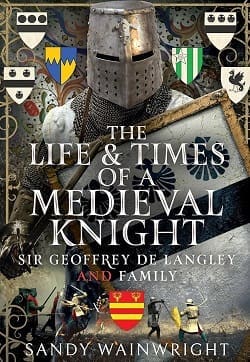
by Sandy Wainwright.
Hardback (6.4×9.5 inches). 254 pages. 2026.
Subtitle: Sir Geoffrey de Langley and Family
If your name is Langley, or connected to a Langley, and you want to know about the Langley (de Langley) family in medieval times, then here is your book. This is not a battle book as much as it is a family history revolving around Sir Geoffrey, who was fortuitous enough to be born into minor nobility and hitched his star to Henry III, who became King. Langleys down the line hewed to royal fealty throughout the turbulent times of rebellions and civil wars, picking the winning side for the most part and having enough leverage on the losing side to avoid the worst of fates from the 12th century to the 15th century.
Insomnia, the internet, an ancestry site, and an “aha!” moment regarding Isabella de la Pole led Wainwright down the rabbit hole of genealogy. As she unearthed more and more digital and paper records, helped by initial Langley research by a couple of professors, she pieced together the family tree (she on the Knowlton branch).
This is not easy, with all the same-named sons and cousins floating around medieval records. Indeed, my brain sometimes melted at trying to keep all the names straight — there’s only so much naming differentiation, but that certainly helped with the main Langleys.
One interesting point: “Fitz” was sometimes, but not always, used to denote illegitimate birth. “Fitz” was also used to mean “son of.” So, the pair of FitzAlan sons were the sons of Alan, but may also have been illegitimate. Not to worry all you Fitz(names) out there — even illegitimate (“bastard”) sons within the medieval social structure could be highly placed and trusted, including within royal circles. “Bastard” stigma apparently increased into our modern times.
The book contains 26 black and white photos, 17 black and white illustrations, seven black and white maps, and 10 family trees of the various main and branches of the de Langley family.
For our purposes, almost no use for a tabletop battle, some use for understanding how family connections contributed to recruitment for campaigns, and exceptional use on how a knight spent his time increasing and managing his land — and his social power. This latter point would make excellent background for a RPG NPC family ensconced in a city and/or county. A successful History check of this NPC or one of his family offers up the genealogical chart. A successful inquiry within the city generates a map of the family holdings. And so on. All the family, noble, and royal connections are already created and based on history. Yes, it’s that extensive.
Enjoyed it.
— Reviewed by Russ Lockwood