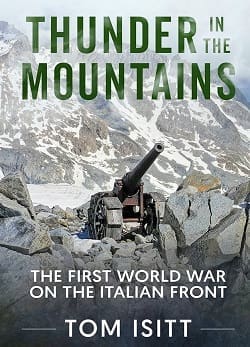
by Tom Isitt.
Softcover (6.6×9.7 inches). 334 pages. 2026.
Subtitle: The First World War on the Italian Front
What a delightful change of pace for a war history. The author bicycled what was the entire WWI front in Italy, with a goodly portion of that in the mountains. And when I say mountains, I mean the Dolomites and the Alps and some of the most insane spots for Italian and Austro-Hungarian troops to shoot at each other.
As he pedals from the top of the Adriatic Sea to the border of Italy and Switzerland, he takes side trips to visit the battlefields — battlefields that were sometimes mere ledges hacked out of the rock. The cabins and other structures were often anchored to the sides of mountains, logistics started with hacking tunnels through rock and glacier, and small-unit raids ruled the days.
Throughout his journey, or should I say journeys for he has visited multiple times, he snaps photos of beautiful snow-capped mountains, awkward mountainside buildings, and various memorials and monuments.
Apparently, when he wasn’t biking along roads paved or abandoned, he was taking side hikes up the side of the mountains and staying in rifugio — public cabins with facilities. Apparently, Italy has a whole network of them along hiking trails.
And then there were his excursions along ferrata trails — trails being a bit of a misnomer. Ferrata consists of either lots of U-shaped iron bars hammered into the rock to create a ladder, or, cables strung along the face of a mountain that you clip on a safety line and inch your way across the rockface. If you fall, the theory is the safety line will save you from a fall of hundreds to thousands of feet. If you want to gain the summits of various mountains, which contain WWI trenches, tunnels, and other positions, you need to “hike” the ferrata trails. A couple of illustrative photos (p114) illustrate the precarious nature of ferrata hiking.
Now, this is interesting enough as a travelogue, but every spot he visits contains a history of the men and units at that spot, often in the context of division- and corp-level offensives. The photos of where these soldiers fought elicit awe for their beauty and the wonder how anyone fought at those altitudes and conditions. When troops weren’t sniping, raiding, or tunneling and counter-mining versus each other, they were battling the bitter cold of winter and the privations of lack of provisions. It’s not like there’s a railroad or road leading to the tops of the peaks.
A tidbit: Italy declared war of Austria-Hungary on May 24, 1915, but only on Germany on August 28, 1916 (pg. x).
A typo: The declaration of war date in the text is May 23, 1915 (p29), so one or the other is right. Also, “thegarrison” (p127) needs a space.
The book contains 71 black and white photos, 88 color photos, four black and white maps with color overlays, and 26 color OpenStreetMaps maps with overlays of the front lines and the main offensives. QRS codes at the start of most chapters provide further photos online.
Mountain warfare in Italy, except for the Caporetto offensive, is little-covered. This a delightful read with the war history interspersed with travel observations. I’m not sure how you’d craft a skirmish scenario among the peaks, but this book will offer all the examples you’d need to craft your own WWI mountain warfare rules. Well done.
Enjoyed it.
— Reviewed by Russ Lockwood