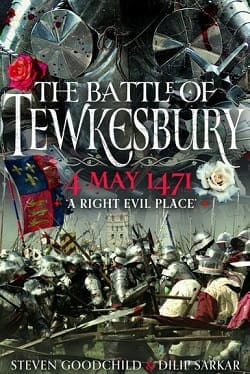
by Steven Goodchild and Dilip Sarkar.
Hardback (6.5×9.5 inches). 266 pages. 2026.
Ah, now there’s a second reason to celebrate the 4th of May: anniversary of the War of the Roses battle and Star Wars Day.
Despite the title, the book starts with Henry V in 1415 and marches through the internecine history of aristocratic plotting and maneuvering leading up to the War of the Roses. This contains a considerable amount of shifting alliances, rebellions, and foreign interventions — not to mention a bewildering array of names and family connections. The only leaders that have higher Roman numerals after their names are the popes.
The campaign swings into action with an excellent analysis of the maneuvers of both sides that led to Tewkesbury. The paths are somewhat well documented, although period commentary gets vague at times — hence the analysis of the march and the intention of the route.
One aspect I enjoy is the comparison of various period commentaries. For example, King Edward IV returned from exile with a force of either: 2,000 troops, 1,500 troops, 2,400 troops, 2,000 troops (again), or 900 English plus 300 Flemish troops (p71), depending on the source.
Chapter 13 (p96-p111) covers the actual battle. However, like the troops numbers, the disposition and progress of the battle remain vague in the period commentaries. These are presented one after another and the contradictory nature of the commentaries is readily apparent. Certainly the maps do an excellent job of presenting the various courses of battle.*
I put an asterisk at the end of that sentence because none of the maps have a scale. Some miles and yardage is within the text, but all maps always need a scale. I have little idea the frontages of the units, the depth of the units, the distances covered, and so on. Same with all the other maps. Kudos for including maps, but a map need a scale. Pity. A lack of a scale also presents difficulties in crafting a tabletop scenario.
The book contains 60 black and white photos, 12 black and white illustrations, and 29 black and white maps. Kudos for the maps, which actually show little towns along the march routes and hedges and hillocks of the battlefield, but they do need a scale.
I especially enjoyed an Appendix that presented a number of dispositions and courses of the tactical battle offered by historians over the last two hundred or so years. When you have vague period commentaries and almost no archeological evidence, these represent interesting opinions about the battle.
Part I is the history and Part II is a battlefield guide along with several appendices. It’s all nicely written and analyzed. Well done.
Enjoyed it.
— Reviewed by Russ Lockwood