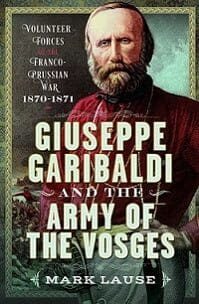
by Mark Lause
Hardback (6.5×9.5 inches). 282 pages. 2026.
Subtitle: Volunteer Forces of the Franco-Prussian War 1870-1871
While Garibaldi is generally well known for his efforts at unifying Italy in the mid 19th century, I had no idea that this advocate for a Universal Republic was commander of the French Army of the Vosges during the Franco-Prussian War. He arrived in Marseilles after Napoleon III surrendered and a republican government was declared in Paris.
Previously bouncing around the world trying to help local forces in South America set up Republics, he found his way to France to become commander of the French Army of the Vosges. However, “Army” is a bit of a misnomer because his collection of international adventurers and assigned French troops could barely be called a regiment, although it grew to be four brigades and thus a small division of about 5,000 to 8,000. Army is an optimistic term. The numbers may be a bit optimistic, too.
It had little in the way of uniforms, arms, and logistics. The new French Army of old Imperial officers sent little his way — not even intelligence reports. Yet Garibaldi’s Army fought in three battles: a loss at Dijon, a successful defense of Autun, and a successful capture of Dijon.
In the end, his numbers were too small to make much more than a local difference. The large French armies surrendered, the new republican government signed an armistice, and most amazingly of all, the armistice did NOT cover the areas in and around the Army of the Vosges.
Think about that. Most of the country was done with fighting, but not the areas around Dijon. The Baden troops were not that keen on continuing the fighting — no one wants to be the last death in a war already with an armistice.
A few typos, mostly concerning lack of commas or spaces, although footnote 35 notes “the fenders” which probably should be “the defenders” (p153) and Prussians “surrendered” should be “surrounded” (p116).
The book contains 13 black and white photos, 15 black and white illustrations, and seven black and white maps — without scales. You’ll find some distances within the text. What is it with a rash of books with scale-less maps? An appendix contains a nice Vosges Army OOB with numbers. That almost makes up for the lack of scales. You’ll need to look up numbers for the Badeners and Prussians.
It’s a last campaign for Garibaldi and a nice slice of the Franco-Prussian War for readers.
Enjoyed it.
— Reviewed by Russ Lockwood