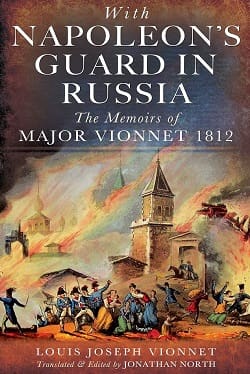
by Louis Joseph Vionnet. Translated and Edited by Jonathan North.
Softcover (6.2×9.2 inches). 209 pages. 2022 reprint of 2012 book.
Subtitle: The Memoirs of Major Vionnet 1812
Major Louis Joseph Vionnet, with the Fusiliers of the French Imperial Guard since 1809, took part in the 1812 invasion of Russia. Much of the text discusses the endless marching through villages, punctuated by acknowledgement of battles, but without much description. He delves into greater detail in later battles, presumably because his regiment of the Imperial Guard was used more often in combat.
He does describe the environs of Moscow in some detail, including witnessing and arresting a “peasant” setting fires in Moscow (p79). Then comes the long march back to France. At least he was smart enough to buy himself fur-lined cloak, a fur riding coat, and food supplies before setting off back to France (p87).
He was made of sterner stuff than many soldiers, enduring frozen wastelands, Cossack attacks, and soldiers who froze to death. The weather is a hot topic in his memoirs.
One interesting note: Napoleon paid his army in rubles, not francs. The Emperor said he paid his troops double when in Russia, but not exactly. He paid a soldier twice as many rubles as francs, but a ruble was only worth about 1/4 of a franc. Do the math and you discover he cut the soldiers’ pay in half (p98).
As Vionnet trudged across the Berezina and into Poland, he stumbled upon a food cache that kept him going. Just as he was about to succumb to fever and starvation in Berlin, Germany, a kindly architect took pity on him and nursed him back for a couple of days to a semblance of health — or at least enough to finally reach France, where he recuperated.
His tale continues into the Spring and Fall 1813 campaigns, where he was wounded enough for Napoleon to take notice. He was made a baron, awarded cash he never received, and his regiment received honors in his name. And that’s where the book ends.
The book contains 27 black and white illustrations and three black and white maps.
It’s a first-hand account and quick read, filled with details about the billets he and fellow officers were quartered in more than the tactical details of 1812 battles. It offers a mid-level officer’s perspective on the campaigns of 1812 and 1813, not to mention the personal travails he encountered on the way in and the way out of Russia.
Enjoyed it.
— Reviewed by Russ Lockwood