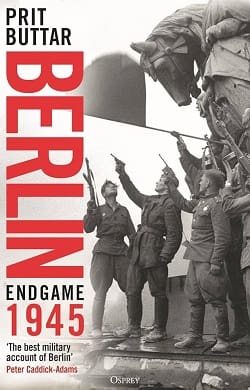
by Prit Buttar
Hardback (6.5×9.5 inches). 456 pages. 2026.
Starting with the opening of Barbarossa — and thankfully brief recap of the Eastern Front to the end of 1944 — the action picks up in January 1945 as the Soviets pushed into Germany proper. By this point, German resources are far lower than what’s needed to stem the Soviet Army.
Starting April 16, it’s a day-by-day narrative of the Soviet offensive to surround and capture Berlin. Desperate defenses amidst urban fighting took a toll on Soviet forces even as fewer and fewer German troops remained. Hitler ordered imaginary formations to relieve Berlin to no effect. Himmler tried to negotiate via neutral country contacts. German commanders and troops tried to head west to surrender to the Western Allies.
Soviet front commanders vied with each other to push the offensive the fastest and furthest. Zhukov, facing the toughest terrain, was particularly keen to capture Berlin, even ignoring front boundaries to do so, before Konev.
The key day is April 22, 1945. Why? After a particularly nasty Hitler tirade about the Army failing him, the Fuhrer stared at the map and said, “Der Krieg ist verloren” (the war is lost). After that, he said to the assembled commanders, “Do whatever you want. I’m not giving any more orders.” (p262)
Buttar uses a lot of long excerpts. He’s done his research, but after a while, all the combat descriptions tend to be similar and in the back half of the book, I tended to skim through the long excerpts. His prose is quite readable — and preferable to combat reports, memoirs, and such.
To me, his prose conjures up the complimentary phrase “like butter.” Only I am tempted to replace that with “like Buttar.” To me, that pun is a high compliment and should be taken as such for such smooth prose.
The book contains 16 black and white photos and 17 black and white maps (just to be clear: with scales).
This is an excellent read, explaining and analyzing the tension among Soviet commanders, the operational maneuvers, and the tactical details for the troops in the foxholes. Well done.
Enjoyed it.
— Reviewed by Russ Lockwood