by Norbert Szamveber
Translated by Blanka Biro. Hardback (6.3×9.5 inches). 375 pages. 2025 translation of 2021 book.
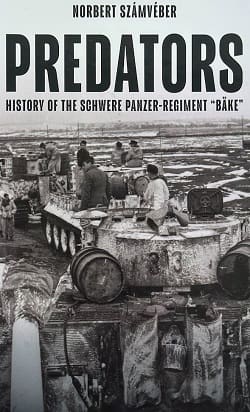
German Schwere Panzer-Regiment Bake consisted of a battalion of Tiger tanks and a battalion of Panther tanks placed under the command of Lt.Col. Dr. Franz Bake — dentist turned talented panzer commander. In January 1944, for a period of about a month and a half, the unit was used as part of the relief force trying to punch through the Soviets to extricate the men in the Korsun Pocket.
Hence, this book is an extremely tactical look at the winter drive to the pocket. Unlike the attempt to reach Stalingrad back in 1942-43, this effort was mostly successful, with about 3/4 of the pocket’s troops able to escape.
The day-by-day account includes weather conditions at the start of each day — kudos for that info for all us tabletop scenario designers. The mud, and there seemed to be lots of mud, caused fuel consumption to be triple normal use.
Attacks, withdrawals, tactics, logistics, successes, and failures all figure into the narrative. Lots of numerical data also gets sandwiched into the text — and the numbers of Soviet tanks destroyed (“burned out” in Soviet nomenclature) and damaged are truly amazing. Fortunately, comparisons of German and Soviet archival reports keep the numbers honest, and where there are discrepancies, a thoughtful analysis helps us understand likely outcomes.
Notably, German heavy tank losses from Soviet fire were low, but from mechanical failure were high (p150). Appendix 2 Losses and Casualties (p251) notes that the Soviets lost 268 tanks, 156 AT/Artillery guns, and 112 trucks from Jan. 24 to Jan. 31, 1944. Regiment Bake started with 34 Tigers and 47 Panthers and came out with 18 Tigers and 15 Panthers — of which four Tigers and four Panthers were lost due to enemy fire and the rest to mechanical issues (p256).
Likewise, every little Soviet village attacked or bypassed is within the text. Two reworked operational maps (plus the hard to read originals) are in the back of the book — more kudos, but I have to take one away because these two maps have no scale. The detailed small tactical maps don’t have scales either. Some yardage is mentioned within the text. And sometimes, you have to watch the spelling discrepancies between the text and map. Frankovka (text) is named Shrankovka (map 6).
It doesn’t help that German battlegroups’ frontage is “from 1,000 to 12,000 meters wide” (p19), which might be 1,200m? Depth is 1,200m. Diagram 3 of a German Tiger heavy panzer company of three platoons of four tanks each (two platoons wide with the third trailing) is listed at 700m across and 400m deep. Diagram 4 shows a five-tank Panther platoon in wedge formation being 400 to 500 meters across. Gunners would take main gun shots at up to 2,000 to 2,500m (p30), although distances cited in the text were generally around 500m or less. Gunners would open up MG fire at 400m (p31).
The book contains 66 black and white photos, two black and white maps, two black and white tank formations, five black and white period visual German OOBs, and 12 color maps.
Also, let’s give Blanka Biro a standing ovation for the translation. This is a most readable unit history, even with all the numerical details.
Detailed. Smooth prose. Tabletop-worthy scenarios. Excellent.
Enjoyed it.
— Reviewed by Russ Lockwood